
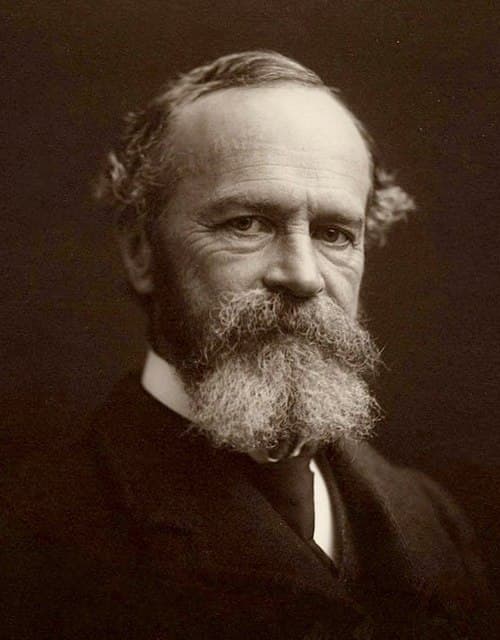
Author
William James
- Lived
- Lived 1842 to 1910
- From
- From American
- Born in
- Born in New York City, New York
Born on January 11, 1842, in New York City, the eldest of five remarkable children of Henry James Sr., a restless Swedenborgian theologian of independent means, and Mary Robertson Walsh. His brother Henry would become the supreme novelist of psychological realism; his sister Alice kept a diary of fierce intelligence published after her death. The family moved ceaselessly through Europe in the elder Henry’s quest for the ideal education; William studied painting under William Morris Hunt, attended schools in Geneva, Paris, and Bonn, and entered Harvard’s Lawrence Scientific School in 1861, eventually earning a medical degree in 1869 that he would never use to practice. A prolonged crisis of depression and doubt in his late twenties was resolved, he later wrote, by choosing to believe in free will. He joined the Harvard faculty in 1872 and stayed for thirty-five years, establishing one of the first experimental psychology laboratories in America. The Principles of Psychology (1890), twelve hundred pages written over twelve years, gave the language the phrase “stream of consciousness” and remains one of the few works of scientific psychology that is also great literature. The Varieties of Religious Experience (1902), based on his Gifford Lectures in Edinburgh, treated religion as lived psychological fact rather than theological argument. Pragmatism (1907) distilled the philosophical method he had developed alongside Charles Sanders Peirce into a public philosophy of consequence and action. James resigned from Harvard in 1907, his health failing. He died of heart failure on August 26, 1910, at his summer home in Chocorua, New Hampshire, at the age of sixty-eight.
In September 1909, walking beside Sigmund Freud after Clark University's psychology conference, James felt an attack of angina coming on. He stopped, handed Freud the bag he was carrying, and asked him to walk on alone while he caught his breath. Freud never forgot it, and wrote that he had always wished he might face his own death as fearlessly.
The first button needs the app on this device; the second gets it there.
In the canon
- The Principles of Psychology1890
- The Will to Believe1897
- The Varieties of Religious Experience1902
- Pragmatism1907
- A Pluralistic Universe1909
- Essays in Radical Empiricism1912