
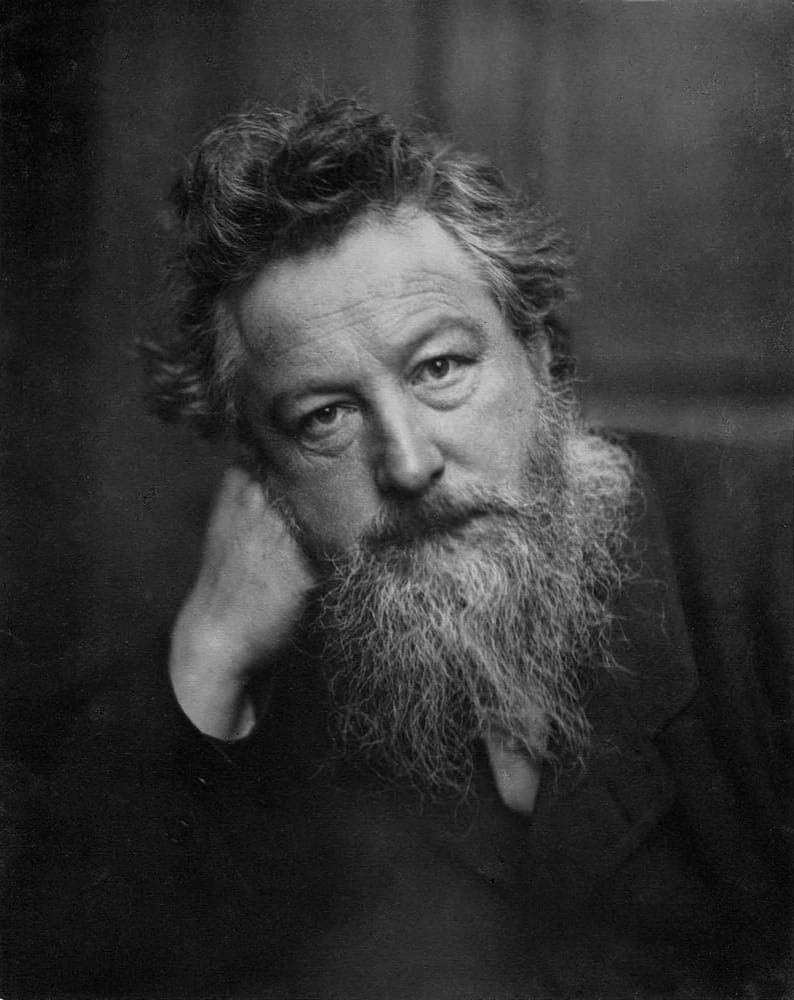
Author
William Morris
- Lived
- Lived 1834 to 1896
- From
- From English
Born on March 24, 1834, in Walthamstow, then a village on the edge of Epping Forest in Essex, William Morris was the son of a prosperous bill broker whose investments in a Devon copper mine left the family wealthy. A solitary, bookish boy, he rode through the forest in a toy suit of armour and read the Waverley novels before he was seven. At Oxford he met Edward Burne-Jones, abandoned plans for the church, and fell under the spell of medieval art and the writings of John Ruskin. He trained briefly as an architect, then as a painter, before founding the decorative firm later known as Morris and Company in 1861, designing the wallpapers, textiles, and stained glass that carried his name into English homes. His poetry made him famous first: The Defence of Guenevere (1858), The Life and Death of Jason (1867), and the vast narrative cycle The Earthly Paradise (1868-1870). He learned Icelandic and traveled twice to Iceland, translating its sagas. In his last decade he turned to revolutionary socialism, lecturing on street corners, and to prose romances and the utopian News from Nowhere (1890), a vision of a London freed from machinery and money. He founded the Kelmscott Press in 1891, whose Chaucer is among the most beautiful books ever printed. He had refused the Poet Laureateship and once declared that he wanted nothing in his house that he did not know to be useful or believe to be beautiful. He died on October 3, 1896, at Kelmscott House in Hammersmith, aged sixty-two, his doctor noting that he had simply worn himself out.
The first button needs the app on this device; the second gets it there.
In the canon
- News from Nowhere1890
- The Well At The World's End1896
- The Water Of The Wondrous Isles1897