
Author
William Wordsworth
- Lived
- Lived 1770 to 1850
- From
- From English
- Born in
- Born in Cockermouth, England
Born on April 7, 1770, in Cockermouth, Cumberland, in the Lake District of northern England, the second of five children of John Wordsworth, an attorney, and Ann Cookson. His mother died when he was seven; his father when he was thirteen. Orphaned and scattered among relatives, Wordsworth attended Hawkshead Grammar School in the heart of the Lakes, where he wandered the fells and absorbed the natural world that would become the great subject of his poetry. At Cambridge he was an indifferent student but a passionate walker. A visit to revolutionary France in 1791 left him intoxicated with radical hope , and, secretly, with Annette Vallon, who bore him a daughter, Caroline, before war between England and France separated them. A legacy from a friend in 1795 allowed him to set up house with his devoted sister Dorothy, whose journals fed his imagination for decades. In 1798, he and Samuel Taylor Coleridge published Lyrical Ballads, the collection that launched English Romanticism: it opened with Coleridge’s “The Rime of the Ancient Mariner” and closed with Wordsworth’s “Tintern Abbey.” The Preface to the 1800 edition, calling for poetry in “the real language of men” and defining it as “the spontaneous overflow of powerful feelings…recollected in tranquillity,” became the movement’s manifesto. He settled at Dove Cottage in Grasmere, married Mary Hutchinson in 1802, and spent decades composing The Prelude, his vast autobiographical poem addressed to Coleridge, published posthumously in 1850. He was appointed Poet Laureate in 1843. Wordsworth died on April 23, 1850, at Rydal Mount, Westmorland, at eighty, having outlived his radical fire but not his feeling for the world.
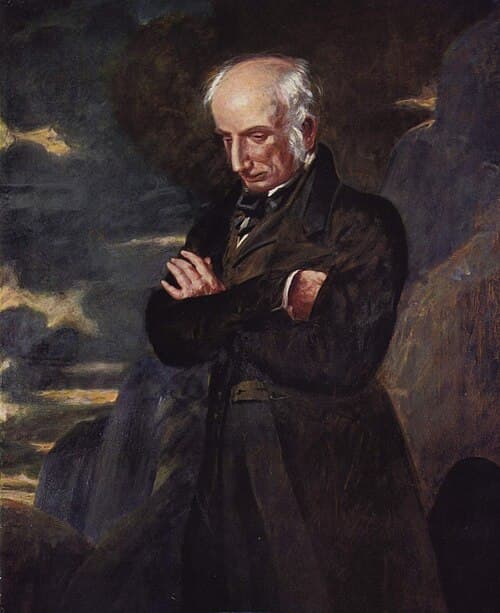
At seventy, Wordsworth climbed Helvellyn, high among the Lake District fells, composing a sonnet on the way up. Two years later the painter Benjamin Haydon set him against storm and crag for the portrait now in the National Portrait Gallery, arms folded, still at home on the mountains that had made him a poet.
The first button needs the app on this device; the second gets it there.
In the canon, 17 works
- Lines Written a Few Miles above Tintern Abbey1798
- The Tables Turned1798
- Expostulation and Reply1798
- Lines Written in Early Spring1798
- We Are Seven1798
- The Idiot Boy1798
- The Thorn1798
- Strange Fits of Passion Have I Known1800
- She Dwelt Among the Untrodden Ways1800
- Three Years She Grew1800
- A Slumber Did My Spirit Seal1800
- Michael1800