
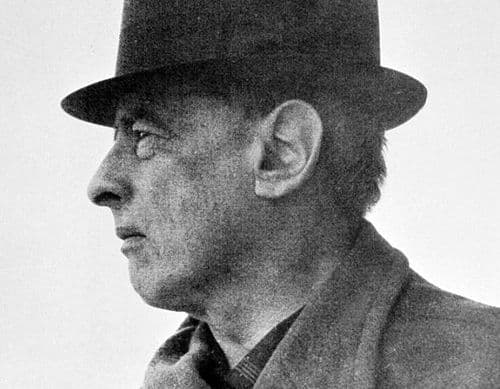
Author
Witold Gombrowicz
- Lived
- Lived 1904 to 1969
- From
- From Polish
- Born in
- Born in Małoszyce, Poland
Born on August 4, 1904, in Małoszyce, a village in central Poland, into the minor landed gentry , a social class he would spend his career anatomizing and mocking. He studied law at the University of Warsaw, practiced briefly, and began writing stories that caught the attention of the literary avant-garde. Ferdydurke (1937), his first novel, was a wild, parodic assault on Polish cultural pretensions, exploring how human beings are deformed by the roles society forces upon them , the tyrannies of form, maturity, and national identity. In August 1939, he sailed for Buenos Aires aboard the maiden voyage of the Polish transatlantic liner Chrobry. By the time the ship docked, Germany had invaded Poland, and Gombrowicz chose not to return. He would remain in Argentina for twenty-four years, living in poverty, without Spanish, cut off from his language’s readers, writing pseudonymous newspaper columns to survive. For five years he produced nothing of consequence. Then came Trans-Atlantyk (1953), a riotous, linguistically inventive semi-autobiography of his stranding, and his Diary (1953–1969), one of the great intellectual journals of the twentieth century, in which he staged elaborate battles with Polish culture, existentialism, and his own vanity. Pornografia (1960) and Cosmos (1965) pushed his obsessions with immaturity and the impossibility of authentic selfhood into increasingly strange territory. He returned to Europe in 1963, settling in Vence, in the south of France, supported by a Ford Foundation grant. Gombrowicz died on July 24, 1969, in Vence, of heart and lung failure, at sixty-four. He remains Poland’s most original modern novelist , perpetually underread, impossible to domesticate.
In 1947, Gombrowicz translated Ferdydurke into Spanish though his own Spanish was rough. He gathered some twenty writers and students, none fluent in Polish, in the smoke of Buenos Aires's Café Rex. Working from French as a bridge, they argued over each sentence for months until the first foreign edition existed.
The first button needs the app on this device; the second gets it there.
In the canon
- Ferdydurke1937
- Trans-Atlantyk1953
- Bacacay1957
- Pornografia1960
- Cosmos1965
- Diary1986