
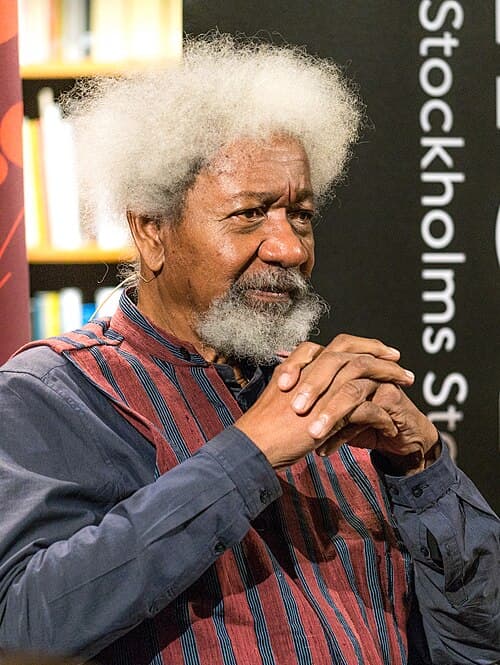
Author
Wole Soyinka
- Lived
- Lived born 1934
- From
- From Nigerian
- Born in
- Born in Abeokuta, Nigeria
Born Akinwande Oluwole Babatunde Soyinka on July 13, 1934, in Abeokuta, a city in western Nigeria, the second of six children. His father, Samuel Ayodele Soyinka, known as “Essay,” was a prominent Anglican headmaster; his mother, Grace Eniola Soyinka, whom he nicknamed “Wild Christian,” was a shopkeeper and political activist. Soyinka grew up between the colonial world of the mission school and the Yoruba traditions of his extended family , a duality that shaped everything he would write. He studied at University College, Ibadan, and then at the University of Leeds, where he read English literature. From 1958 to 1959 he worked as a dramaturgist at the Royal Court Theatre in London, absorbing European theatrical technique before returning to Nigeria, where he founded acting companies and plunged into the cultural ferment of independence. A Dance of the Forests (1960), written for the independence celebrations, was already a warning: it refused to sentimentalize the African past. His plays , The Lion and the Jewel (1963), The Road (1965), Death and the King’s Horseman (1975) , draw on Yoruba cosmology and ritual to confront power, sacrifice, and the collision of worlds. During the Nigerian Civil War, Soyinka appealed publicly for a ceasefire. He was arrested in 1967 and held as a political prisoner for twenty-two months, much of it in solitary confinement; The Man Died (1972), his prison memoir, recorded the ordeal. In 1986, he became the first African writer to receive the Nobel Prize in Literature, dedicating his acceptance speech to Nelson Mandela, then still imprisoned. Soyinka has lived in exile and returned, taught at universities across the world, and continued to write and speak against tyranny into his tenth decade.
In October 1965, Soyinka was accused of storming a Nigerian radio station at gunpoint and swapping a rigged election broadcast for a tape denouncing the fraud. Charged with armed robbery, he was acquitted after a witness testified the gunman was bearded and Soyinka, two hours earlier, had been clean-shaven.
The first button needs the app on this device; the second gets it there.
In the canon
- A Dance of the Forests1960
- The Road1965
- The Interpreters1965
- Kongi's Harvest1967
- The Man Died1972
- Death and the King's Horseman1975
- Aké: The Years of Childhood1981