
Author
Wu Cheng'en
- Lived
- Lived 1500 to 1582
- From
- From Chinese
- Born in
- Born in Lianshui, Jiangsu
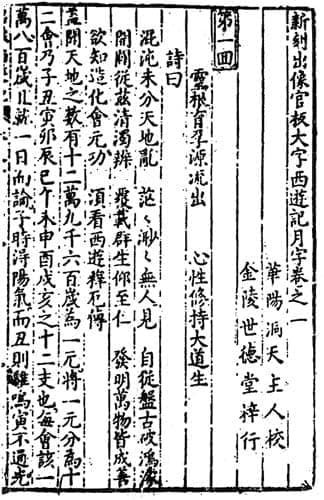
Born around 1500 in Lianshui in Jiangsu province during the Ming dynasty, Wu Cheng'en took the courtesy name Ruzhong and later moved with his family to Huai'an. His father Wu Rui had shown an aptitude for study but ended his life as an artisan because of the family's poverty, passing on instead a love of classical literature, folk anecdote, and popular tale to his son. Wu sat the imperial examinations repeatedly without passing them, gaining entry to the imperial university at Nanjing only in middle age. He held minor posts in Beijing and as assistant magistrate in Changxing County, but the work bored him, the corruption disgusted him, and he resigned to spend the rest of his life in Huai'an writing poems and stories, befriending other Ming literary men, and living mostly as a hermit. He never had children and remained poor. Late in life, against the fashion for classical imitation, he wrote Journey to the West in the vernacular, drawing on the seventh-century pilgrimage of the monk Xuanzang to India and the great cycle of folk tale that had grown around it. The hundred-chapter novel of the monk, the rebellious Monkey King Sun Wukong, the pig Zhu Bajie, and the river demon Sha Wujing was published anonymously in 1592, a decade after his death, because fiction was thought vulgar; his hometown attributed it to him almost at once, but most of China learned of his authorship only after Hu Shih's research in the early twentieth century. In one of his few surviving poems Wu described himself as having a defiant spirit. He died in Huai'an around 1582, in his early eighties, in obscurity.
In 1567, as assistant magistrate of Changxing, Wu had a violent local strongman jailed for assaulting the county's tax collectors. The man's family bribed their way free, then filed a counter-complaint, and inspectors arrested Wu himself on invented embezzlement charges. Cleared eventually, he never trusted official life again.
The first button needs the app on this device; the second gets it there.
In the canon
- Journey to the West1592