
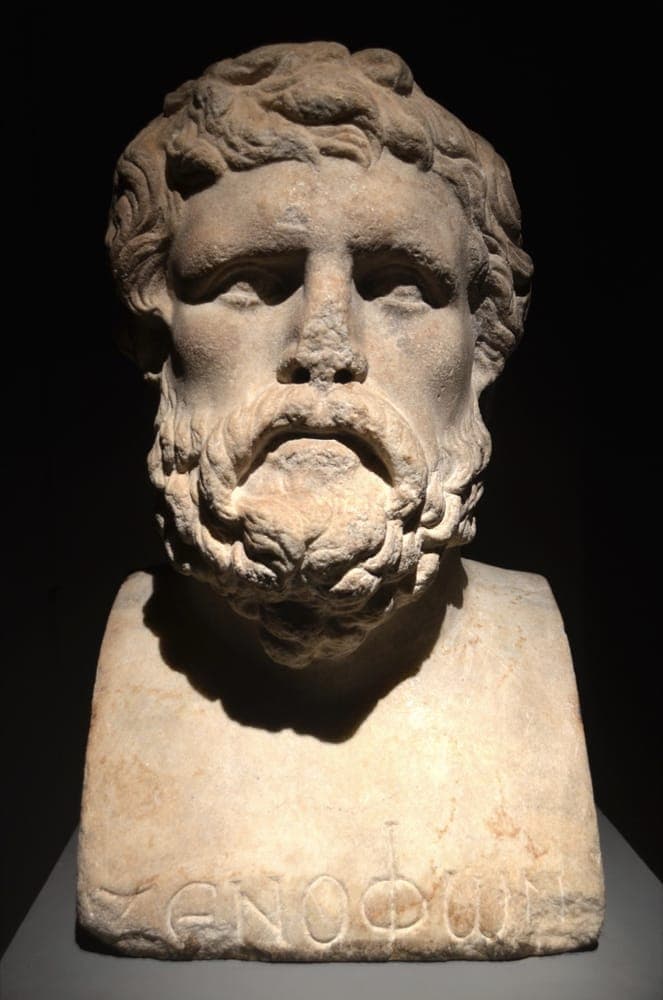
Author
Xenophon
- Lived
- Lived 430 BCE to 354 BCE
- From
- From Ancient Greek
- Born in
- Born in Erchia, Attica, Greece
Born around 430 BCE in the deme of Erchia, in the countryside near Athens, to a wealthy equestrian family, Xenophon came of age in a city ruined by the long war with Sparta. He fell into the circle of Socrates, who, legend holds, once blocked his path with a staff and asked where men go to become good, then bade the young man follow him. In 401 BCE, against Socrates's counsel, Xenophon joined a force of Greek mercenaries marching east to help Cyrus the Younger seize the Persian throne. Cyrus died at Cunaxa, the Greek generals were treacherously killed, and the ten thousand stranded soldiers elected Xenophon among their leaders. Their fighting retreat north to the Black Sea became the Anabasis, his account of the march, with its famous cry of "The sea, the sea" when the men at last glimpsed the water that meant home. He wrote much else. The Hellenica continues Thucydides's history of Greece; the Memorabilia and Apology defend the memory of his teacher; the Cyropaedia (around 370 BCE) imagines the education of a prince. He composed practical treatises on horsemanship, hunting, and household management, and the Symposium, a dinner conversation in Socrates's company. Exiled from Athens for his Spartan sympathies, he was given an estate at Scillus by his admirers in Sparta, where he farmed, hunted, and wrote in long retirement. When the Thebans overran the region he withdrew to Corinth. The decree of exile was eventually repealed, and his sons fought for Athens. He died around 354 BCE, an old man who had outlived nearly everything he once knew, his clear soldier's prose surviving him.
After Cunaxa, with the Greek generals seized by the Persians, Xenophon lay sleepless in a camp where nobody was preparing to fight. Dozing at last, he dreamed that a bolt of lightning struck his father's house and set it ablaze. He woke asking himself why he was lying there, and went to rouse the captains of his dead friend Proxenus.
The first button needs the app on this device; the second gets it there.
In the canon
- Anabasis390 BCE
- Conversations of Socrates371 BCE
- A Persian Expedition370 BCE
- Cyropaedia370 BCE
- A History of My Times362 BCE