
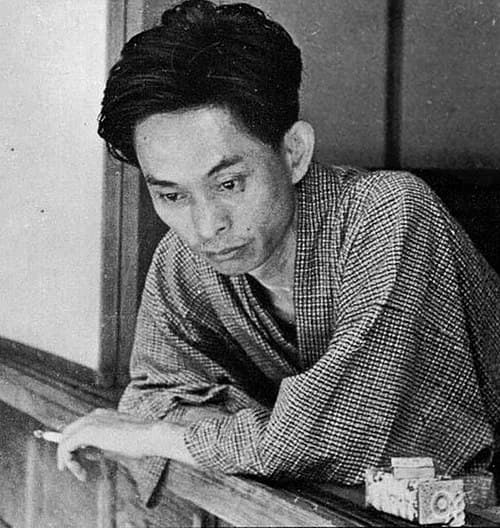
Author
Yasunari Kawabata
- Lived
- Lived 1899 to 1972
- From
- From Japanese
- Born in
- Born in Osaka, Japan
Born on June 11, 1899, in Osaka, Japan, into a prosperous family that dissolved around him with devastating swiftness: his father, a physician, died when he was two; his mother the following year. Raised by his grandparents, Kawabata lost his grandmother at seven and his grandfather at fifteen, leaving him entirely alone. He later called himself a specialist in funerals. He moved to Tokyo to study at the First Higher School, then entered the English literature department at Tokyo Imperial University, where he became involved in the Shinkankakuha (New Sensation) literary movement of the 1920s, which sought to fuse Japanese aesthetics with European modernist technique. The Izu Dancer (1926), a lyrical novella about a student’s encounter with a young traveling performer, established his reputation for delicate, emotionally restrained prose. Snow Country (1935–1947), written in installments over more than a decade, tells of a Tokyo dilettante’s doomed affair with a provincial geisha in a remote hot-spring town; its opening sentence , “The train came out of the long tunnel into the snow country” , is among the most celebrated in Japanese literature. Thousand Cranes (1952) and The Sound of the Mountain (1954) explored aging, desire, and the persistence of the past with an austere beauty indebted to classical Japanese art. In 1968 he became the first Japanese writer to receive the Nobel Prize in Literature, honored for “narrative mastery, which with great sensibility expresses the essence of the Japanese mind.” The suicide of his protégé Yukio Mishima in 1970 deeply shook him. On April 16, 1972, Kawabata was found dead in his apartment in Zushi, having gassed himself. He was seventy-two. He left no note.
In May 1914, alone with his blind, dying grandfather, sixteen-year-old Kawabata kept a diary of the old man's final days: the sickroom's smell, his own flashes of irritation, the small kindnesses he forced himself to perform. His grandfather died six days after the diary breaks off.
The first button needs the app on this device; the second gets it there.
In the canon
- The Dancing Girl of Izu1926
- The Master Of Go1951
- Thousand Cranes1952
- The Sound of the Mountain1954
- Snow Country1956
- The Old Capital1962
- Beauty and Sadness1964