
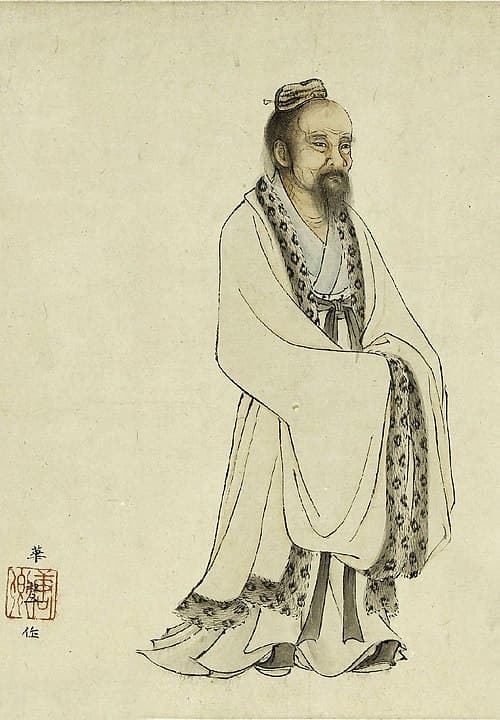
Author
Zhuang Zhou
- Lived
- Lived 369 BCE to 286 BCE
- From
- From Chinese
- Born in
- Born in Meng, in the state of Song (present-day Henan, China)
Born around 369 BCE in the town of Meng, in the state of Song , present-day Shangqiu, in Henan province, China , during the Warring States period, an era of political fragmentation, military violence, and extraordinary philosophical creativity. Almost nothing certain is known of his life. The sole biographical account appears in Sima Qian’s Records of the Grand Historian, written some two centuries after Zhuang Zhou’s death, which describes him as a minor official who once served as a lacquer garden superintendent. Sima Qian records that King Wei of Chu sent emissaries bearing rich gifts to invite Zhuangzi into government service; Zhuangzi laughed and told them he would rather drag his tail in the mud like a free tortoise than be venerated as a sacred relic in a royal temple. His thought was influenced by Laozi, and the text that bears his name , the Zhuangzi , became, alongside the Tao Te Ching, one of the two foundational works of Daoism. Its Inner Chapters, the seven sections most reliably attributed to Zhuang Zhou himself, are among the most inventive and linguistically playful philosophical writings ever produced: parables, dialogues, jokes, paradoxes, and sudden shifts in perspective that dissolve the certainties of language, identity, and knowledge. The Butterfly Dream , in which Zhuangzi dreams he is a butterfly and, upon waking, cannot determine whether he is a man who dreamed of being a butterfly or a butterfly now dreaming of being a man , remains the most famous thought experiment in Chinese philosophy. He is believed to have died around 286 BCE, though even this is uncertain. The Zhuangzi insists that death is merely another transformation, no more alarming than the turning of the seasons.
In one of his book's most retold scenes, his wife dies and his friend Huizi comes to mourn, only to find Zhuang Zhou sitting on the ground, drumming on a tub and singing. He had wept at first, he explains, then saw her death as one more turn of the seasons, and the weeping stopped.
The first button needs the app on this device; the second gets it there.
In the canon
- Zhuangzi300 BCE