
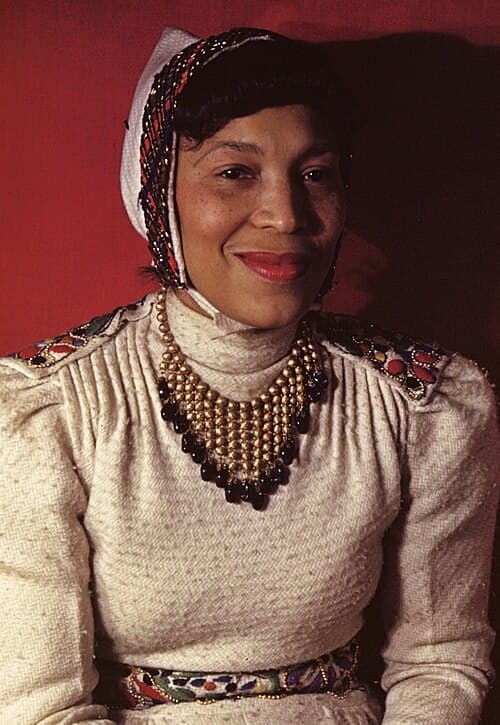
Author
Zora Neale Hurston
- Lived
- Lived 1891 to 1960
- From
- From American
- Born in
- Born in Notasulga, Alabama
Born on January 7, 1891, in Notasulga, Alabama, though she later claimed 1901 as her birth year and Eatonville, Florida, as her birthplace , a town she loved too much not to claim as her origin. Eatonville, near Orlando, was the first incorporated all-Black municipality in the United States, and Hurston grew up there surrounded by the storytelling, sermons, and vernacular speech that would become the raw material of her art. She described it as “a city of five lakes, three croquet courts, three hundred brown skins, three hundred good swimmers, plenty guavas, two schools, and no jailhouse.” Her mother, Lucy Ann, died in 1904 when Zora was thirteen, and her home life fractured. At sixteen she joined a traveling Gilbert and Sullivan troupe as a maid, eventually making her way to Baltimore, then Washington, and finally New York. She studied at Howard University and won a scholarship to Barnard College, where she became the sole Black student and studied anthropology under Franz Boas, the father of the field. She collected folklore across the rural South and in Haiti and Jamaica, an experience that produced Mules and Men (1935) and Tell My Horse (1938). Their Eyes Were Watching God (1937), written in seven weeks in Haiti, follows Janie Crawford from voicelessness to selfhood through three marriages and a hurricane; it is now regarded as a masterpiece of American fiction, though the Harlem Renaissance establishment , Richard Wright among them , dismissed it at the time. Dust Tracks on a Road (1942), her autobiography, was both celebrated and criticized for its refusal to conform to expected racial narratives. In her final years Hurston worked as a maid, a librarian, and a substitute teacher in Fort Pierce, Florida. She died on January 28, 1960, in a welfare home and was buried in an unmarked grave. In 1973, Alice Walker found the grave and placed a marker reading: “A Genius of the South.”
In 1928, collecting folk songs at a Florida sawmill camp, Hurston made an enemy of a woman named Lucy, who believed she wanted the same man. Lucy came at her with a knife in the jook joint. Big Sweet, the fearless woman who had adopted her, flew in with an open blade, and Hurston fled the camp for New Orleans.
The first button needs the app on this device; the second gets it there.
In the canon
- Jonah's Gourd Vine1934
- Mules and Men1935
- Their Eyes Were Watching God1937
- Moses, Man of the Mountain1939
- Dust Tracks on a Road1942
- Seraph on the Suwanee1948