
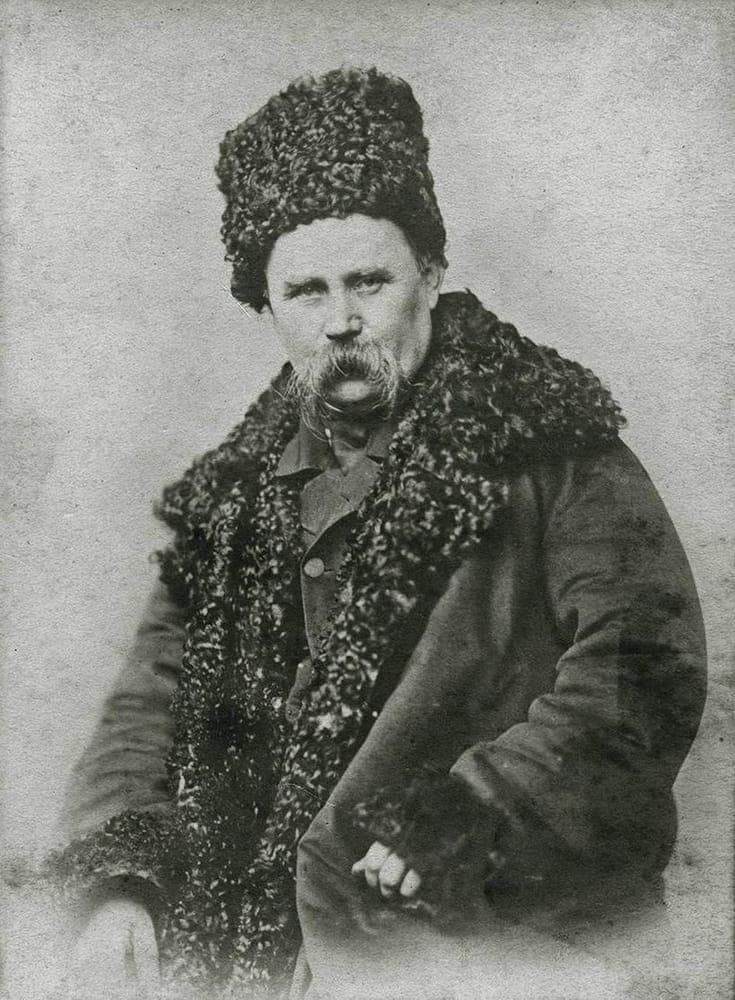
Author
Taras Shevchenko
- Lived
- Lived 1814 to 1861
- From
- From Ukrainian
- Born in
- Born in Moryntsi, Kyiv Governorate
Born on March 9, 1814, in the village of Moryntsi in the Kyiv Governorate of the Russian Empire, Taras Hryhorovych Shevchenko was born a serf on the estate of Pavel Engelhardt, the property of his master from infancy. His mother died when he was nine and his father two years later. As a boy he wandered with one master after another, drawing in chalk on whatever surface he could find, the gift everyone around him recognised as undeniable. In 1831 his master took him to St. Petersburg as a household servant and, finding the boy moonlighting as a draughtsman in the city's gardens, apprenticed him to a guild painter. There the young Karl Briullov, the most celebrated Russian painter of the day, met him by chance, and what followed became one of the famous emancipation stories of the century. Briullov painted a portrait of the poet Vasily Zhukovsky, who arranged for it to be raffled at court for 2,500 roubles, the sum required to purchase Shevchenko's freedom. He was twenty-four. Two years later, in 1840, he published Kobzar, eight poems in Ukrainian at a moment when Ukrainian had been forbidden in print since the 1720s and the language was officially considered a dialect of Russian. The book made him at once the voice of a nation that did not yet know it was one. Haidamaky (1841), an epic on the 1768 Cossack-peasant uprising, followed. He returned to Ukraine in 1843, traveling and painting, and in 1846 joined the Brotherhood of Saints Cyril and Methodius, a clandestine pan-Slavic society in Kyiv. The brotherhood was betrayed in 1847. Tsar Nicholas I read Shevchenko's confiscated poems himself and added to his sentence in his own hand the prohibition that the prisoner was to be held under the strictest surveillance, with the explicit ban on writing or painting. He was conscripted as a private and sent to a desert garrison at Orenburg, then to a fort on the Aral Sea. He wrote anyway, in tiny notebooks hidden in the tops of his boots, the so-called zakhalyavni knyzhechky. Released in 1857 after ten years, broken in health, he returned to St. Petersburg and resumed publishing. He died on March 10, 1861, the day after his forty-seventh birthday, two months before the abolition of serfdom in the Russian Empire. His body was carried by hand from St. Petersburg to Kaniv on the Dnipro and reburied on Chernecha Hill, per his Testament: when I am dead, then bury me in my beloved Ukraine. The Ukrainian literary tradition stands on his shoulders. The country's stamps, currency, and central avenues bear his name. The bard of his title became, irrevocably, the bard of Ukraine.
In September 1860, six months before he died, the Imperial Academy of Arts named Shevchenko Academician of Engraving, for an etching after Rembrandt's Parable of the Workers in the Vineyard. A man the empire had once owned as property spent his final free year formally certified as one of its finest printmakers.
The first button needs the app on this device; the second gets it there.
In the canon, 17 works
- Kateryna1838
- Tarasova Nich1838
- Ivan Pidkova1839
- Perebendya1839
- The Poplar1839
- Haidamaky1841
- The Dream1844
- Zapovit (My Testament)1845
- The Caucasus1845
- The Heretic1845
- The Servant Girl1845
- Testament1845