
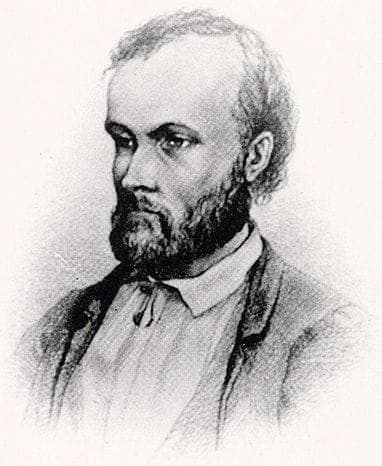
Author
Aleksis Kivi
- Lived
- Lived 1834 to 1872
- From
- From Finnish
- Born in
- Born in Nurmijärvi, Finland
Aleksis Kivi was born Alexis Stenvall on October 10, 1834, in the village of Palojoki in Nurmijärvi, in the Grand Duchy of Finland, the son of Erik Johan Stenvall, a village tailor, and Anna-Kristiina Hamberg. At twelve he was sent to school in Helsinki, where he learned Swedish; the money ran out in 1852 and he went on studying alone, and in 1859 he entered the University of Helsinki, where Fredrik Cygnaeus lectured on drama and Elias Lönnrot on the Kalevala. His mother hoped he would become a priest. He chose instead to write, and to write in Finnish, signing his work Kivi while remaining Stenvall in every register. His verse tragedy Kullervo, drawn from the Kalevala, won a Finnish Literature Society competition in 1860, and his village comedy The Heath Cobblers took the first state literary prize in 1865 against a field that included Johan Ludvig Runeberg. From the summer of 1864 he lodged at Fanjunkars, a croft in Siuntio, with Charlotta Lönnqvist, a woman some twenty years older who gave him room and board for almost nothing. His play Lea was staged in Helsinki in May 1869, a single performance from which Finnish-language theatre dates its beginning. At Fanjunkars he wrote Seven Brothers, the story of seven unruly brothers who flee to the forest rather than learn to read, now regarded as the first significant novel written in Finnish. It appeared in installments in 1870, but August Ahlqvist's review in Finlands Allmänna Tidning savaged it and the publisher stopped selling the parts. Poverty, debt, drink and insomnia wore him down; in the spring of 1871 he was taken to hospital in Helsinki and then to the Lapinlahti asylum, where doctors diagnosed melancholia. Released in February 1872, he went to live with his brother Albert at Syvälahti in Tuusula, and he died there on December 31, 1872, aged thirty-eight. His birthday is kept in Finland as Finnish Literature Day.
In 1869 Charlotta Lönnqvist, who had housed and fed him at Fanjunkars for five years, came close to losing the croft at a forced auction over her debts. Kivi put his fee for Seven Brothers toward what she owed and asked Professor Thiodolf Rein to stand as guarantor, and the house where he was writing the novel stayed hers.
The first button needs the app on this device; the second gets it there.
In the canon
- Seven Brothers1870