
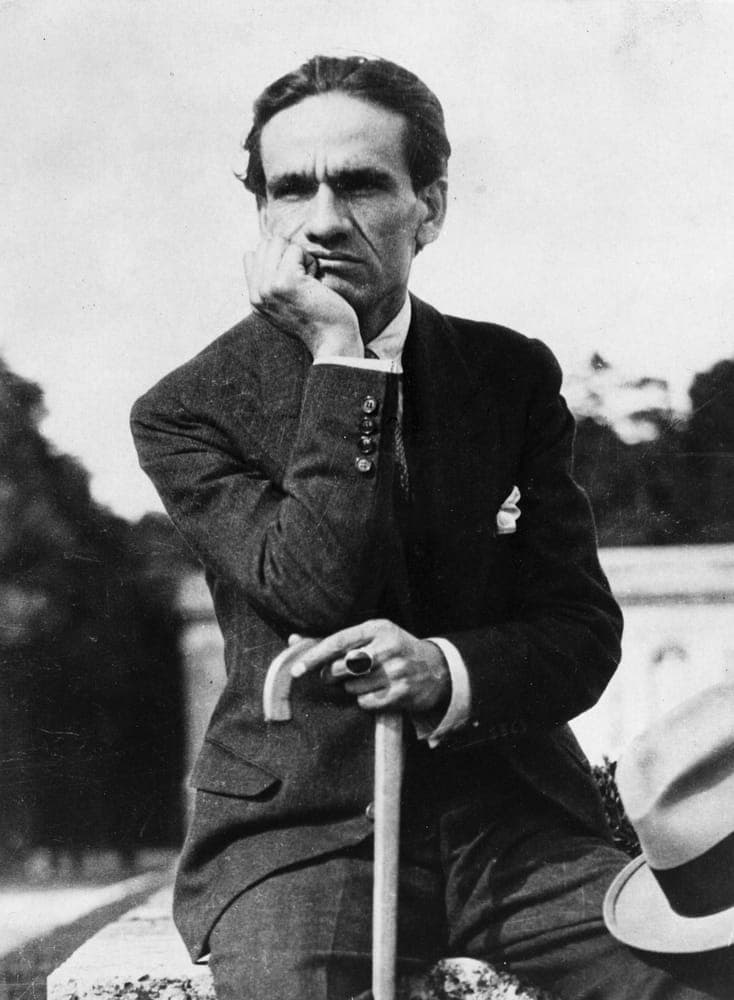
Author
César Vallejo
- Lived
- Lived 1892 to 1938
- From
- From Peruvian
- Born in
- Born in Santiago de Chuco, Peru
Born on March 16, 1892, in Santiago de Chuco in northern Peru, César Abraham Vallejo Mendoza was the youngest of eleven children of Francisco de Paula Vallejo and María de los Santos Mendoza, whose fathers were Spanish priests and whose mothers were Indigenous Peruvians, and his parents hoped he would enter the priesthood. Short of money, he left university for a time to work on the Roma sugar estate, where he saw the exploitation of the labourers at first hand, before taking his bachelor's degree in letters in 1915. In Trujillo he fell in with the young writers later called the Grupo Norte, among them Antenor Orrego and Víctor Raúl Haya de la Torre, and in 1919 he published Los heraldos negros, poems of grief and doubt written partly in the shadow of Rubén Darío. In November 1920 he was arrested on a false charge of joining the looting and burning of a house in his home town and held for 112 days, and in 2007 Peru's judiciary formally declared that he had been unfairly accused. Trilce (1922), seventy-seven untitled poems that invent words and wrench syntax apart, was printed in two hundred copies in the workshops of the Lima penitentiary and met near silence; it is now read as one of the founding books of the Latin American avant-garde. In June 1923 he sailed for Europe and never saw Peru again. In Paris he lived in poverty, met Georgette Philippart, whom he married in 1934, and travelled three times to the Soviet Union; expelled by the French police in 1930 for communist propaganda, he spent a period in Madrid, where he knew Unamuno, García Lorca and Alberti, and joined the Peruvian Communist Party in 1931. The Spanish Civil War gave him his last subject: he returned to Spain in 1937 for the Second International Writers' Congress and wrote the fifteen poems of España, aparta de mí este cáliz. He died in Paris on April 15, 1938, aged 46, and the poems he left in manuscript appeared the following year as Poemas humanos.
In November 1920 Vallejo was arrested in Trujillo, accused of helping to loot and burn a house in his home town of Santiago de Chuco. He spent 112 days in jail. On Christmas Eve, still a prisoner, he took second prize in the city's poetry contest under a pseudonym; the jury declared the first prize void.
The first button needs the app on this device; the second gets it there.
In the canon
- Trilce LXV1922
- Mass1937
- Black Stone on a White Stone1938