

Author
Charles Lyell
- Lived
- Lived 1797 to 1875
- From
- From Scottish
- Born in
- Born in Kinnordy, Scotland
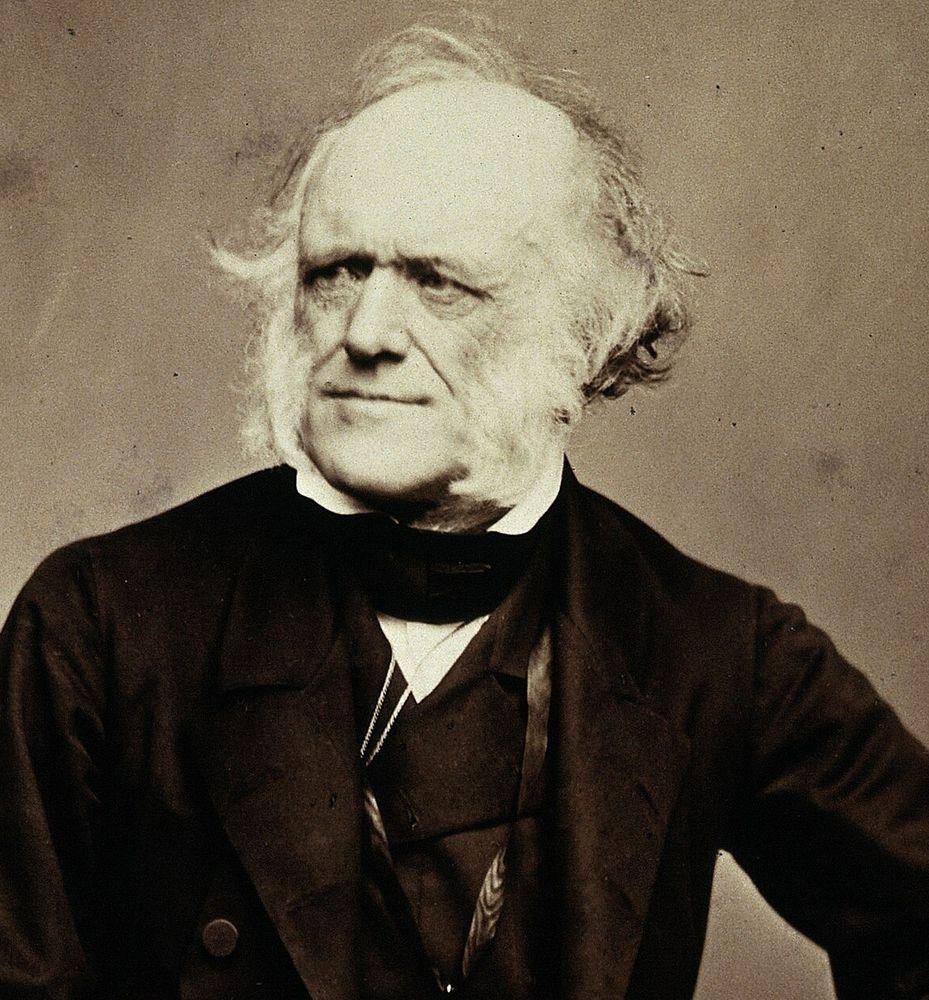
Born on 14 November 1797 at Kinnordy House, near Kirriemuir in Forfarshire, Charles Lyell was the eldest of ten children of a botanist and Dante scholar, and he spent much of his boyhood at Bartley Lodge on the edge of the New Forest, collecting insects. At Exeter College, Oxford, he heard William Buckland lecture on geology, and although he took a degree in classics in 1819 and entered Lincoln's Inn in 1820 to read for the bar, failing eyesight and a stronger appetite for rocks drew him away from the law. He became joint secretary of the Geological Society in 1823, and in 1828 he travelled through the volcanic Auvergne and on into Italy with Roderick Murchison, studying Vesuvius, Etna and the ruins of the Bay of Naples. The book that came out of that journey, Principles of Geology (three volumes, 1830 to 1833), argued that the earth had been shaped by the same slow causes still at work, rain and rivers, earthquakes and volcanoes, acting across immense spans of time rather than through sudden catastrophes. It ran to twelve editions, the last appearing after his death, and it changed how a generation of naturalists looked at the ground beneath them. In 1832 he married Mary Horner in Bonn; a keen student of shells, she became his companion in fieldwork across Europe and on two long visits to North America in the 1840s, which he described in Travels in North America (1845) and A Second Visit to the United States (1849). He held the chair of geology at King's College London, was knighted in 1848 and made a baronet in 1864. With Joseph Hooker he arranged the joint reading of the papers of Charles Darwin and Alfred Russel Wallace in 1858, and in Geological Evidences of the Antiquity of Man (1863) he set out the case for humanity's deep past, though he came round to natural selection only slowly and cautiously. He died in London in 1875 and was buried in Westminster Abbey.
In 1828 Lyell stood among the three marble columns of the old Roman market at Pozzuoli, near Naples. High up each shaft ran a band of holes bored by marine molluscs: since Roman times the ground had sunk beneath the sea and risen again, quietly, without catastrophe. He made those columns the frontispiece of Principles of Geology.
The first button needs the app on this device; the second gets it there.
In the canon
- Principles of Geology1830
- Geological Evidences Of The Antiquity Of Man1863