

Author
Christopher Columbus
- Lived
- Lived 1451 to 1506
- From
- From Italian
- Born in
- Born in Genoa, Italy
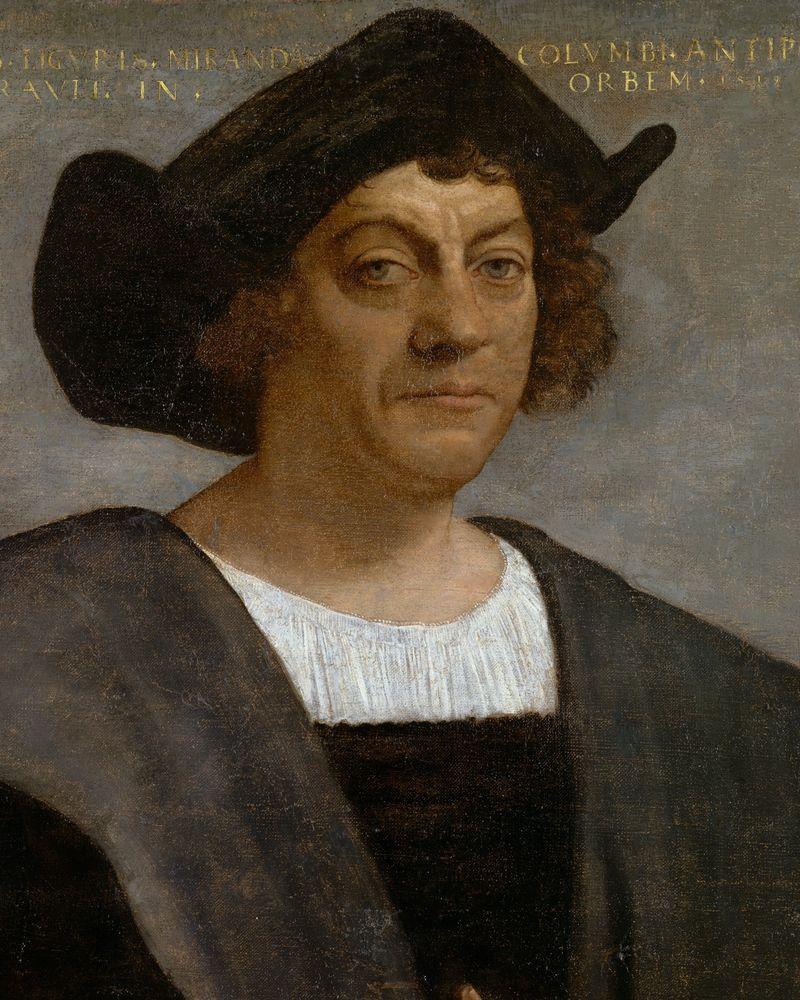
Christopher Columbus was born in the Republic of Genoa between late August and the end of October 1451, the son of Domenico Colombo, a wool weaver, and Susanna Fontanarossa; no record gives the day. He went to sea young, trading as far as Chios in the Aegean, and in August 1476, when the Genoese convoy he sailed with was attacked off southern Portugal, his ship went down and he came ashore near Lagos. He settled in Lisbon, where his brother Bartholomew made charts, married Filipa Moniz Perestrelo, whose late father had sailed for Prince Henry the Navigator, and voyaged as far as the Portuguese fort at Elmina on the Gold Coast. Reading Ptolemy, Pierre d'Ailly and Marco Polo, and misreading an Arabic mile for a shorter Italian one, he came to believe Asia lay a short sail west. Portugal turned him down, and so for years did Spain, until in April 1492 Ferdinand and Isabella agreed terms at Santa Fe that made him Admiral of the Ocean Sea and governor of whatever he found. He left Palos with three ships in August 1492 and made landfall in the Bahamas on 12 October. Three more voyages followed, in 1493, 1498 and 1502, through the Caribbean to the coasts of South and Central America. As governor of Hispaniola he ruled the Taíno through tribute, forced labour and war, his own settlers rose against him, and in 1500 the royal investigator Francisco de Bobadilla sent him home in chains. Restored to favour but never to his government, he spent his last voyage marooned for a year on Jamaica. His letters, the journal of his first crossing, which survives only in Bartolomé de las Casas's abstract, and the Book of Privileges and Book of Prophecies he compiled in his last years are the record he left. He died in Valladolid on 20 May 1506, never conceding that the lands he had reached were not Asia. No portrait made from life survives; the likeness shown here is Sebastiano del Piombo's portrait of 1519, of a man said to be Columbus.
Stranded on Jamaica in 1504, with the islanders tired of feeding his crews, Columbus learned from his almanac that the moon would be eclipsed. He told the caciques that God would show his anger in the sky. As the moon rose darkened they ran to the ships with food, and he shut himself in his cabin until it cleared.
In manus tuas, Domine, commendo spiritum meum (Into your hands, Lord, I commend my spirit).
The first button needs the app on this device; the second gets it there.
In the canon
- The Four Voyages of Christopher Columbus1493
- The Logbook Of Christopher Columbus1493