
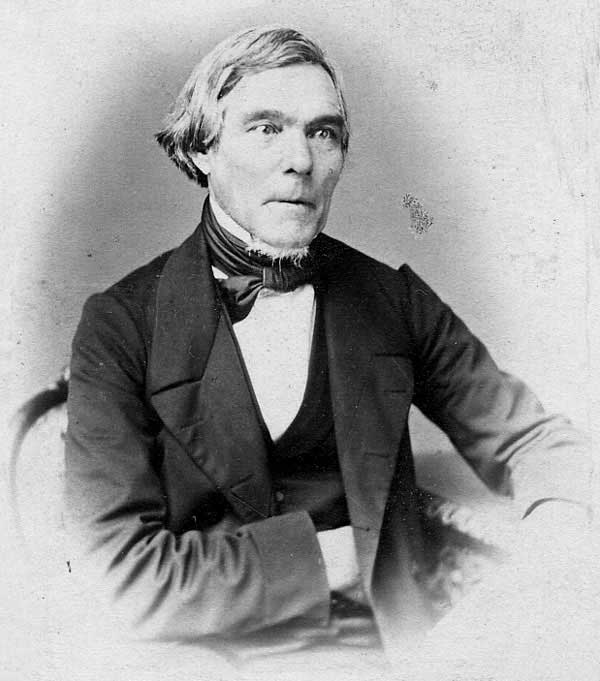
Author
Elias Lönnrot
- Lived
- Lived 1802 to 1884
- From
- From Finnish
- Born in
- Born in Sammatti, Finland
Elias Lönnrot was born on April 9, 1802, at the Paikkari croft in Sammatti, in the Finnish province of Uusimaa, the fourth child of the village tailor Fredrik Johan Lönnrot and his wife Ulrika Wahlberg. His eldest brother noticed the boy's hunger for books and sent him to school at Tammisaari in 1814, and later to the cathedral school in Turku, where he paid his way by sewing clothes and singing for coins until the money ran out. After a spell as an apothecary's apprentice in Hämeenlinna he entered the Academy of Turku in 1822, in the same years as Johan Ludvig Runeberg and J. V. Snellman, and found his life's subject while tutoring in the household of the surgeon Johan Agapetus Törngren, where his interest in Finnish poetry and the Finnish language first woke. His master's thesis of 1827 was on Väinämöinen, and in 1828 he set out on the first of his collecting journeys, through Häme, Savo and North Karelia, coming home with some six thousand lines of verse. He helped found the Finnish Literature Society in 1831, took his medical doctorate in 1832, and in 1833 became district physician of Kajaani, a town of fewer than four hundred people with no hospital, in a region swept by famine and typhoid. He held the post for twenty years, and on his leaves travelled deep into Russian Karelia, Lapland and later Estonia, writing down what the rune singers sang. From those songs he built the Kalevala, published in 1835 and 1836 in thirty-two poems and 12,078 lines, and again in 1849 in its fuller form of fifty poems and 22,795 lines, the version still read and translated today. The Kanteletar followed in 1840. He married Maria Piponius in 1849 and outlived four of their five children. Appointed professor of Finnish at Helsinki in 1853, he went on to write the first Finnish-language flora and to compile a Finnish-Swedish dictionary of more than 200,000 words, coining terms such as kirjallisuus, literature, along the way. He died in Sammatti on March 19, 1884, aged eighty-one.
In late April 1834, on his fifth collecting journey, Lönnrot reached the village of Latvajärvi in Russian Karelia to hear the old singer Arhippa Perttunen. For three days he wrote the songs down, and paid three and a half riksdaler for them. By later reckoning, Perttunen sang a third of the poems that became the Kalevala.
The first button needs the app on this device; the second gets it there.
In the canon
- The Kalevala1835