

Author
Epicurus
- Lived
- Lived 341 BCE to 270 BCE
- From
- From Ancient Greek
- Born in
- Born in Samos, Greece
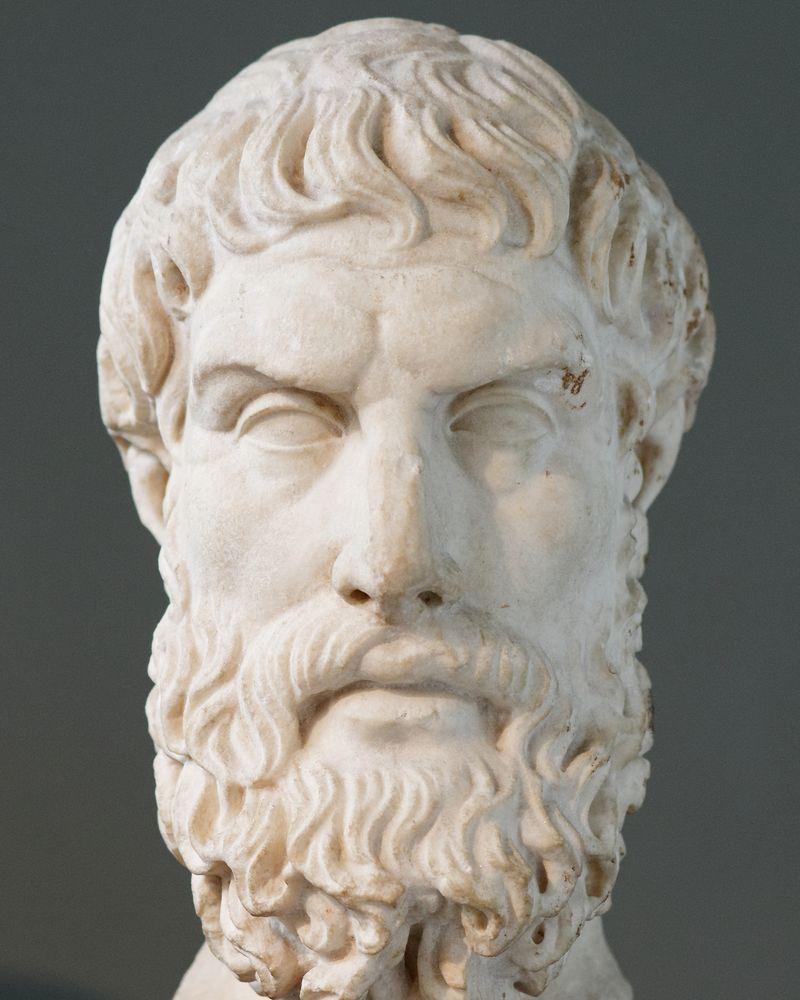
Born in 341 BCE on the island of Samos, Epicurus was the son of Neocles and Chaerestrate, Athenian citizens of the deme of Gargettus who had gone out to the island as settlers. By his own account he turned to philosophy at fourteen, and as a young man he heard the Democritean Nausiphanes at Teos, though he later insisted that he had taught himself. At eighteen, in 323 BCE, he went to Athens for his military training, arriving while Xenocrates was lecturing at the Academy and Aristotle was at Chalcis. After Alexander's death the regent Perdiccas expelled the Athenian settlers from Samos, and Epicurus joined his father in exile at Colophon. Around 311 BCE he began to teach, first at Mytilene on Lesbos and then at Lampsacus on the Hellespont, and in 306 BCE he came back to Athens and bought a house and garden for eighty minae. The Garden became a school and a household at once, open to women and to slaves, among them his own slave Mys, and its members lived plainly and held friendship to be among the greatest goods. His teaching joined the atomism of Democritus to an ethics of calm: the world is made of atoms moving through the void, the gods take no interest in human affairs, the soul dies with the body, and the good life is pleasure understood as freedom from pain in the body and from fear in the mind. He wrote some three hundred rolls, including thirty-seven books On Nature; what survives whole is three letters and the forty Principal Doctrines, preserved by Diogenes Laertius, and a collection of sayings found in a Vatican manuscript in 1888. He died in Athens in 270 BCE, at seventy-two, and left the Garden to his successor Hermarchus. Two centuries later the Roman poet Lucretius set his whole system into verse in On the Nature of Things.
Epicurus said he came to philosophy as a boy on Samos, out of contempt for his schoolmasters. The class was reading Hesiod, whose account of creation begins with Chaos, and not one of the teachers could tell him what Chaos meant. He went looking for the answer himself, and found it at last in atoms moving through an endless void.
The first button needs the app on this device; the second gets it there.
In the canon
- The Art of Happiness300 BCE