
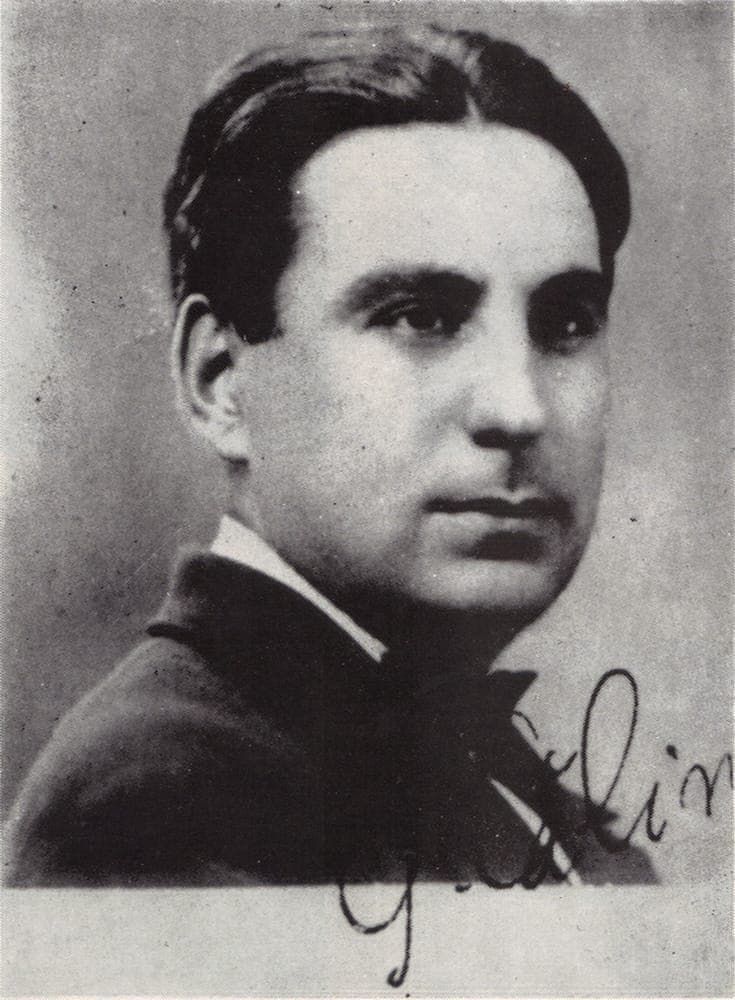
Author
G. Călinescu
- Lived
- Lived 1899 to 1965
- From
- From Romanian
- Born in
- Born in Bucharest, Romania
G. Călinescu was born Gheorghe Vișan on June 19, 1899, in Bucharest, the son of Maria Vișan, a housekeeper, and was raised by her employers, the railway clerk Constantin Călinescu and his wife, who adopted him as a small child and gave him the surname he would sign with a single initial for the rest of his life. He grew up between Iași and Bucharest, a mediocre pupil, and studied letters in Bucharest from 1919, where the Italianist Ramiro Ortiz turned him toward Italian literature. A state scholarship took him to the Romanian School in Rome from 1923 to 1928, under the historian and archaeologist Vasile Pârvan, whom he held up as a model for anyone. Back home he taught Italian and philosophy in high schools, wrote for the reviews of the interwar capital, and in 1932 published The Life of Mihai Eminescu, a biography of the national poet. A doctorate on Eminescu followed in Iași, where he taught aesthetics and criticism, and so did his own novels: The Book of the Wedding (1933), and The Enigma of Otilia (1938), a Balzacian picture of a Bucharest family circling an old miser's money, seen by a young orphan in love with the miser's ward. In 1941 he published his History of Romanian Literature from Its Origins to the Present, one man's account of an entire literature, which a nationalist critic attacked as philosemitic and unpatriotic; its first, complete form was not reprinted until 1982. After 1945 he taught at the University of Bucharest, sat in parliament for Botoșani until his death, entered the Romanian Academy and made his peace with the Communist regime, which sidelined him for some years and then gave him an institute of literary history to run. The novels Poor Ioanide (1953) and The Black Chest of Drawers followed. He died in March 1965 and is counted with Titu Maiorescu and Eugen Lovinescu among the great Romanian critics.
As a boy in the Călinescu household he treated the family's servant, Maria, with contempt. Only in adolescence did he learn that she was his mother, and that his father was a young relative of the house who had refused to acknowledge him. The discovery marked him for life, and he spent decades keeping his origins quiet.
The first button needs the app on this device; the second gets it there.
In the canon
- Enigma Otiliei1938
- Bietul Ioanide1953