

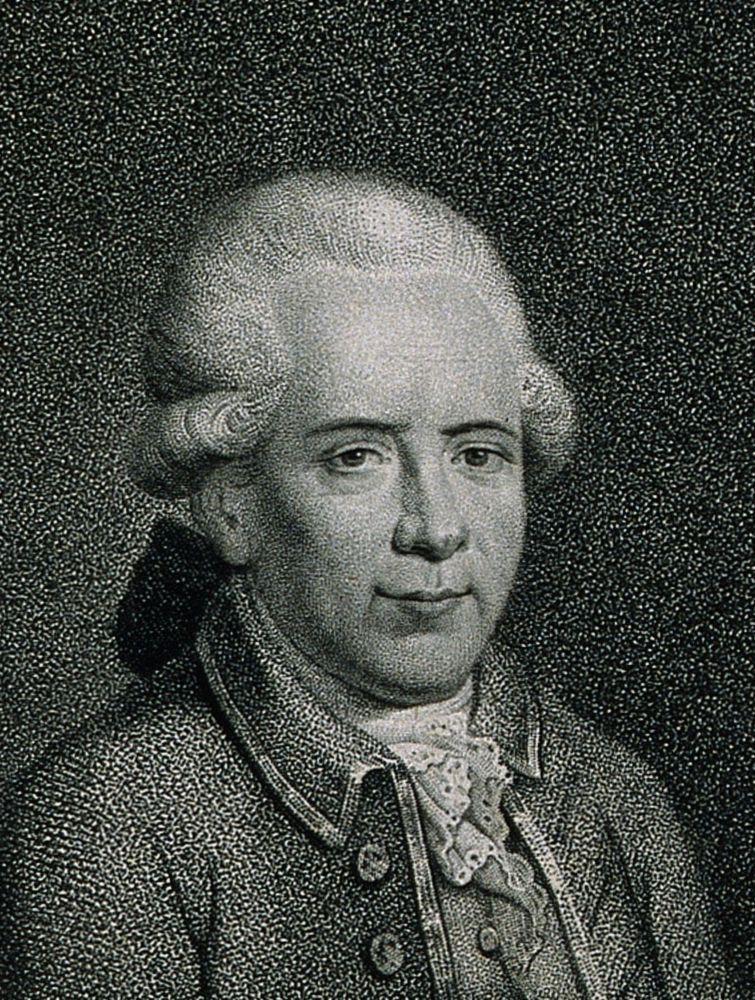
Author
Georg Christoph Lichtenberg
- Lived
- Lived 1742 to 1799
- From
- From German
- Born in
- Born in Ober-Ramstadt, Germany
Georg Christoph Lichtenberg was born on 1 July 1742 in Ober-Ramstadt, near Darmstadt in the Landgraviate of Hesse-Darmstadt, the youngest of seventeen children of Johann Conrad Lichtenberg, a pastor who rose to be superintendent at Darmstadt, and of Katharina Henriette Eckard, herself a pastor's daughter. A fall in childhood left his spine malformed, and he grew up hunchbacked and unusually short, a condition that worsened with the years and in the end affected his breathing. Taught at home until he was ten and then at the Latin school in Darmstadt, he wanted to study mathematics; his mother petitioned Landgrave Ludwig VIII for the money, and in 1763 he entered the University of Göttingen, where he stayed for the rest of his life. He became extraordinary professor of physics in 1769 and ordinary professor in 1775, the first in Germany to hold a chair given explicitly to experimental physics, and one of the first anywhere to lecture with apparatus on the table; Alexander von Humboldt was among his students, and in 1784 Alessandro Volta came to Göttingen to see his experiments. Two visits to England, in 1770 and from 1774 to 1775, made him a lifelong Anglophile, and his Briefe aus England described David Garrick on the stage. In 1777 a large electrophorus showed him the branching star patterns in dust that still carry his name as Lichtenberg figures. From 1778 he published the Göttinger Taschen Calender, and from 1794 his Ausführliche Erklärung der Hogarthischen Kupferstiche, a commentary on Hogarth's engravings. He mocked the physiognomist Lavater in print, was elected to the Royal Society in 1793, and in 1789 married Margarethe Kellner, with whom he had six children. Through all of it he kept private notebooks, lettered A to L, which he called Sudelbücher after the waste books of English merchants. He died in Göttingen on 24 February 1799, aged fifty-six, and only after his death did his family bring the notebooks into print, where they made him one of the great aphorists of the Western tradition.
In 1777 the travelling conjuror Jacob Philadelphia came to Göttingen to give a show. Lichtenberg, who took him for a magician passing off tricks as physics, had a satirical placard put up in the town, advertising in Philadelphia's name a list of ever more preposterous miracles. The conjuror, seeing himself exposed, left Göttingen without performing once.
The first button needs the app on this device; the second gets it there.
In the canon
- The Waste Books1770
- Aphorisms1800