

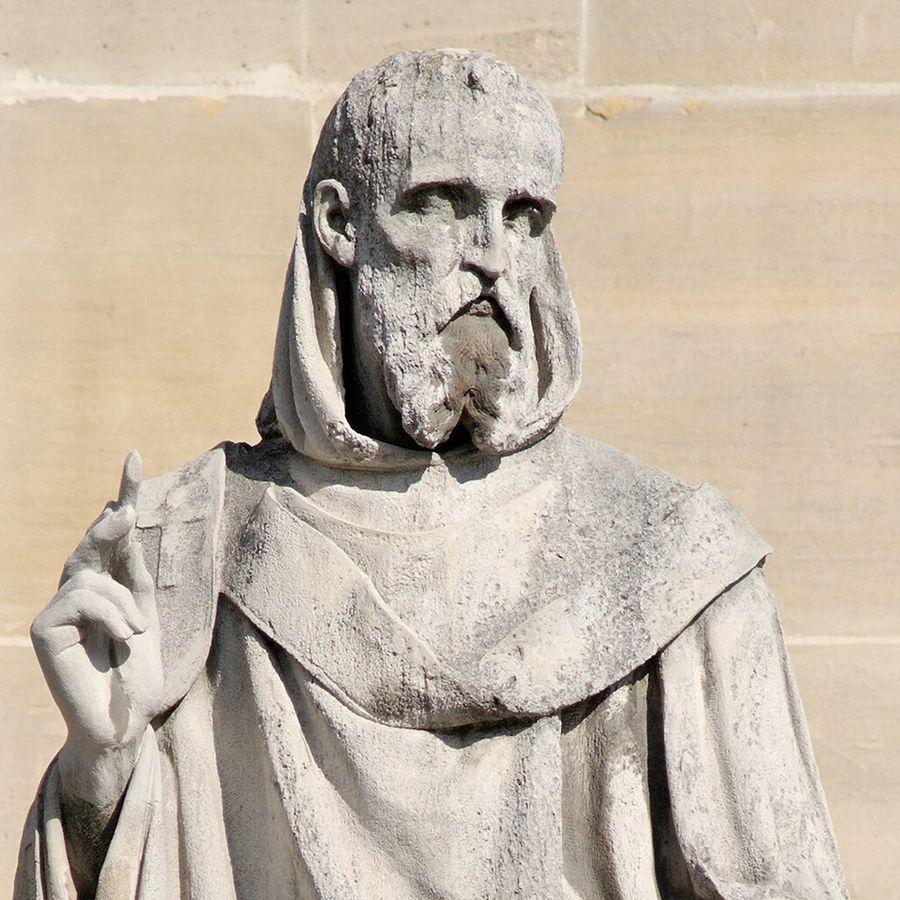
Author
Gregory of Tours
- Lived
- Lived 538 CE to 594 CE
- From
- From Gallo-Roman
- Born in
- Born in Clermont, France
Georgius Florentius was born around 538 at Clermont in the Auvergne, on the feast of Saint Andrew by his own account, into one of the senatorial families that still held the high offices of Roman Gaul under its Frankish kings. His father, Florentius, died while he was a boy; his mother, Armentaria, was a niece of Bishop Nicetius of Lyon, and he later took the name Gregory in memory of her grandfather Gregory, bishop of Langres. He was brought up by his uncle Gallus, bishop of Clermont, and after Gallus died in 554 he was taught by the priest Avitus, who gave him Scripture in place of the classical authors, a gap he apologised for in nearly every preface he wrote. A grave illness, and a recovery he credited to Saint Martin, drew him into the Church, and Avitus ordained him deacon. In 573 the clergy and people of Tours chose him to succeed Bishop Euphronius, and on 22 August, aged thirty-four, he became the nineteenth bishop of the city that kept Martin's tomb. Tours lay across the fault line of the Merovingian civil wars and passed between Sigebert, Chilperic, Guntram and Childebert II, and for twenty years Gregory dealt with kings, queens, counts and fugitives claiming sanctuary in Martin's church; in 580 he came through a charge of slandering Queen Fredegund. Through all of it he wrote: four books on the miracles of Saint Martin, the Glory of the Martyrs, the Glory of the Confessors, the twenty lives of the Life of the Fathers, and above all the Ten Books of Histories, known since as the History of the Franks, which begins at the Creation and becomes, book by book, an account of his own lifetime and of people he knew. He rebuilt the fire-ruined cathedral of Tours and dedicated it in 590. He died at Tours on 17 November 594, or by some reckonings 593, and his History remains the principal witness to sixth-century Gaul.
In 580 King Chilperic summoned the bishops to his villa near Soissons to try Gregory for saying that Queen Fredegund had slept with the bishop of Bordeaux. Outside, a crowd shouted that a bishop of God could not have said such things even of a slave. Masses were said at three altars, and Gregory swore his innocence.
The first button needs the app on this device; the second gets it there.
In the canon
- A History of the Franks594 CE