

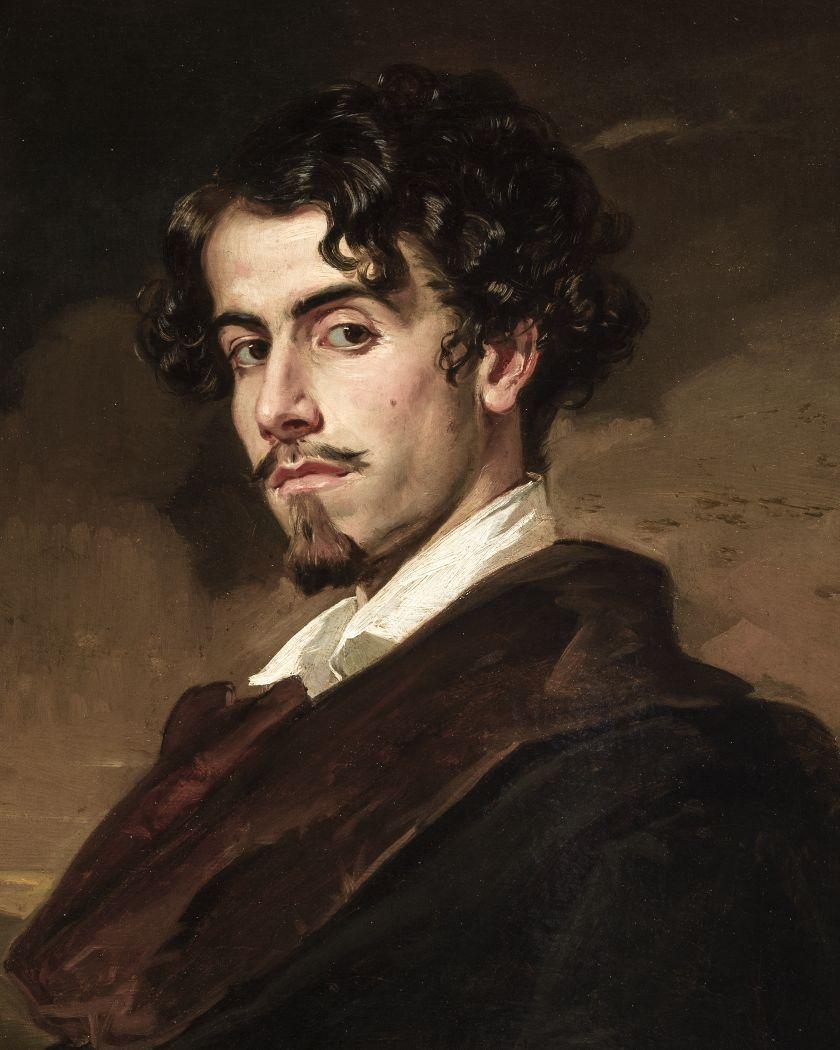
Author
Gustavo Adolfo Bécquer
- Lived
- Lived 1836 to 1870
- From
- From Spanish
- Born in
- Born in Seville, Spain
Gustavo Adolfo Bécquer was born Gustavo Adolfo Claudio Domínguez Bastida on 17 February 1836 in Seville, the son of José Domínguez Bécquer, a painter of Sevillian scenes who signed his canvases with an old family surname, Bécquer, that both his sons would later take as their own. His father died in 1841 and his mother, Joaquina Bastida, in 1847, leaving him an orphan at eleven. He boarded at the naval college of San Telmo until it closed, studied painting under a relative, Joaquín Domínguez Bécquer, and read his way through the library of his godmother, Manuela Monnehay. In October 1854 he left for Madrid to make a name in letters and found poverty, hack work, zarzuelas written with friends, and the lung trouble that never left him. In 1857 he launched, with others, an ambitious Historia de los templos de España. Around 1858 he courted the singer Julia Espín, whom critics take for the muse of several of his poems, and in May 1861 he married Casta Esteban; they had three sons. Journalism kept the household, above all El Contemporáneo, where he published most of his Leyendas, tales of haunted mountains, green-eyed water spirits and moonlit obsessions, and where in 1864 appeared the nine letters Desde mi celda, sent from the Cistercian monastery of Veruela beneath the Moncayo, where he had gone with his brother Valeriano for the mountain air. Late that year the conservative minister Luis González Bravo made him the official censor of novels, a well-paid post he left as the revolution of September 1868 drove the queen and González Bravo into exile. The manuscript of his poems, apparently in the minister's house, was lost in the upheaval, and Bécquer rewrote them from memory in a notebook he called the Libro de los gorriones, the Book of the Sparrows. Valeriano died in September 1870, and Gustavo followed him on 22 December, at thirty-four. The next year his friends published his Obras, and the Rimas, short poems of love, absence and the limits of words, became the starting point of modern Spanish lyric poetry.
In 1857, short of money in Madrid, Bécquer and his friend Ramón Rodríguez Correa took posts as scribes in the government office that administered national property. By the account of another friend, the writer Julio Nombela, Bécquer spent his hours there drawing scenes from Shakespeare's plays instead of copying documents, and he was dismissed for it.
The first button needs the app on this device; the second gets it there.
In the canon
- Rima LIII (Volverán las oscuras golondrinas)1871