

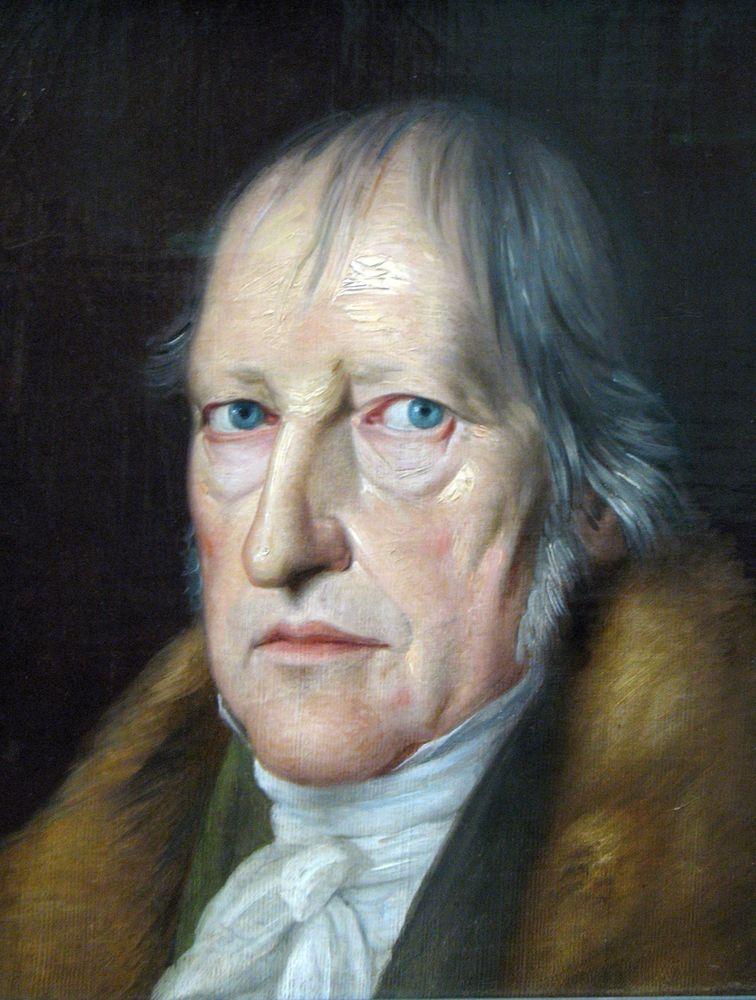
Author
G.W.F. Hegel
- Lived
- Lived 1770 to 1831
- From
- From German
- Born in
- Born in Stuttgart, Germany
Georg Wilhelm Friedrich Hegel was born on 27 August 1770 in Stuttgart, in the Duchy of Württemberg, the eldest child of Georg Ludwig Hegel, a secretary in the ducal revenue office, and Maria Magdalena Fromm, who died of a fever in 1783, when he was thirteen. In 1788 he entered the Protestant seminary at Tübingen, where he shared rooms with the poet Friedrich Hölderlin and the young philosopher Friedrich Schelling, and the three followed the French Revolution with open enthusiasm. Rather than enter the church he became a house tutor, in Bern from 1793 and in Frankfurt from 1797, in a post Hölderlin found for him. A small inheritance on his father's death in 1799 took him to Jena in 1801, where he lectured without salary beside Schelling and in 1807 published the Phenomenology of Spirit, the account of consciousness climbing from bare sensation to absolute knowing. With Jena ruined by the war and no salary in prospect, he edited a newspaper in Bamberg, then from 1808 ran a gymnasium in Nuremberg, where he married Marie von Tucher in 1811 and wrote the Science of Logic (1812 to 1816). A chair at Heidelberg followed in 1816, and the Encyclopaedia of the Philosophical Sciences in 1817. In 1818 he took the Berlin chair left empty since Fichte's death, and there he became the most influential philosopher in Germany, publishing the Elements of the Philosophy of Right (1820) and lecturing to crowded halls on history, religion, the history of philosophy and art; he served as rector of the university in 1829 and 1830. He died in Berlin on 14 November 1831, aged sixty-one, during a cholera epidemic. His students assembled his lectures into books after his death, the lectures on aesthetics among them, and his thought passed through Marx, Kierkegaard and the existentialists into every corner of modern philosophy.
In October 1806 Hegel sat in Jena with the last pages of his first great book just posted to his publisher in Bamberg, afraid the war would lose them in the mail. On the 13th French troops entered the town, and he watched Napoleon ride out to survey the ground. The next day the Prussian army was broken outside Jena.
The first button needs the app on this device; the second gets it there.
In the canon
- Phenomenology of Mind1807
- Introductory Lectures on Aesthetics1835