
Author
Harold Bloom
- Lived
- Lived 1930 to 2019
- From
- From American
- Born in
- Born in New York City, United States
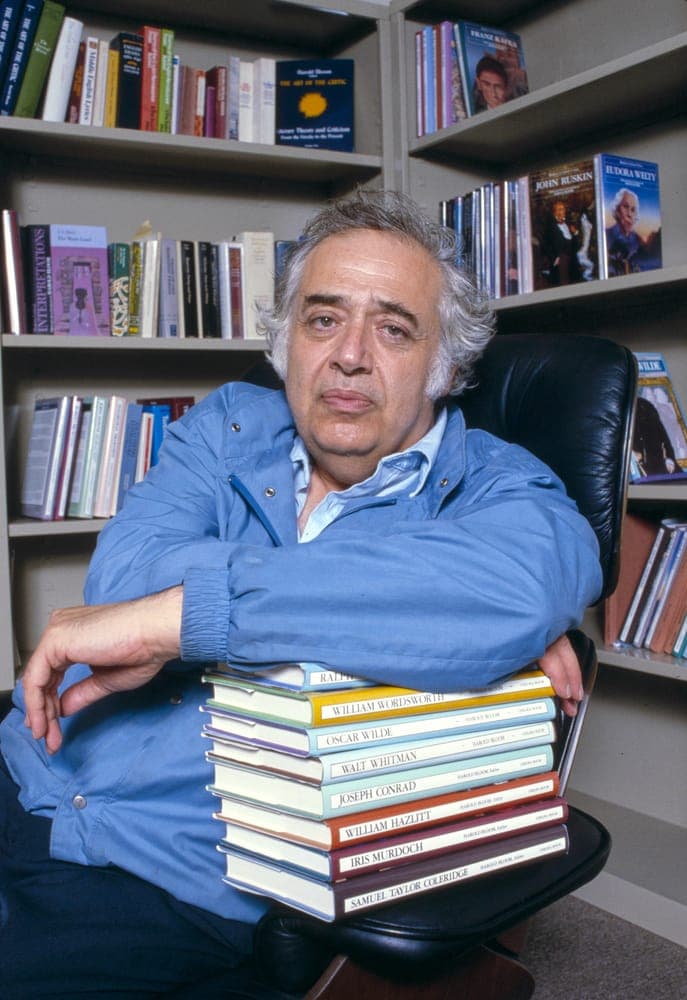
Born on July 11, 1930, in the East Bronx, to William Bloom, a garment worker born in Odesa, and Paula Lev Bloom, a Lithuanian Jew, Harold Bloom grew up in an Orthodox, Yiddish-speaking household and did not learn English until he was six. The first book he read was an anthology of Yiddish poetry; he then found the Melrose branch of the New York Public Library and worked through Hart Crane, William Blake, W. H. Auden and T. S. Eliot, beginning a devotion to the Romantic and visionary poets that never left him. He took a B.A. in classics at Cornell in 1951, studying under M. H. Abrams, spent 1954 and 1955 as a Fulbright scholar at Pembroke College, Cambridge, and received his Ph.D. from Yale in 1955, the year he joined its English department. He stayed for the rest of his life. He married Jeanne Gould in 1958, and they had two sons, David and Daniel. His first book, Shelley's Mythmaking, appeared in 1959, and after years of writing on Blake, Yeats and Wallace Stevens, The Anxiety of Influence (1973) made his name, arguing that strong poets are formed by their struggle with the poets who came before them. He received a MacArthur Fellowship in 1985, reached the bestseller lists with The Book of J (1990), and in The Western Canon (1994) defended the traditional canon against the deconstructionists, feminists and multiculturalists he called the School of Resentment. Shakespeare: The Invention of the Human followed in 1998 and How to Read and Why in 2000. Sterling Professor of Humanities at Yale, and for years Berg Professor of English at New York University as well, he published more than forty books, and he taught at Yale until the week before he died, on October 14, 2019, in New Haven, at the age of 89.
Langdon Hammer, a colleague at Yale, remembered Bloom walking to class with his eyes closed and his mouth moving silently, the effect, Hammer said, being "of a sort of ship." Jesse Zuba, his co-editor, once found him already pacing the halls of Linsly-Chittenden two hours before his seminar was due to start.
The first button needs the app on this device; the second gets it there.
In the canon
- How to Read and Why2000