

Author
James Cook
- Lived
- Lived 1728 to 1779
- From
- From English
- Born in
- Born in Marton, England
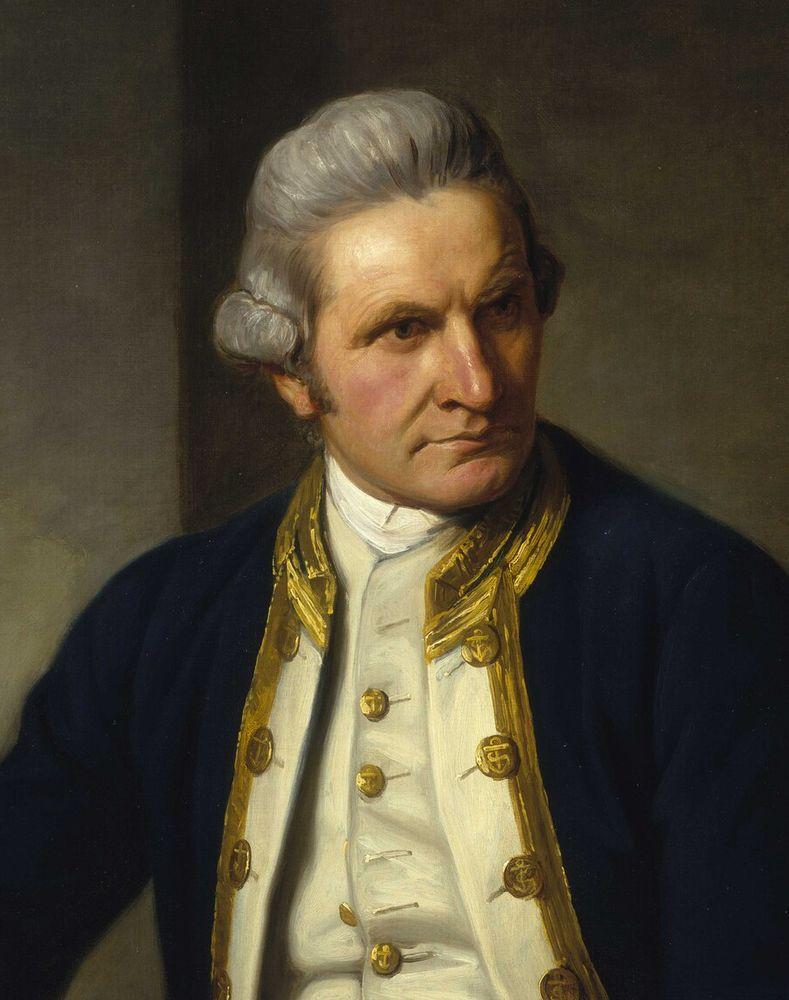
Born on 7 November 1728, 27 October by the Old Style calendar England still kept, in the village of Marton in the North Riding of Yorkshire, James Cook was the second of eight children of a Scottish farm labourer and Grace Pace of Thornaby-on-Tees. When the family moved to Airey Holme farm at Great Ayton, his father's employer, Thomas Skottowe, paid for the boy's schooling. At sixteen he went to work behind the counter of William Sanderson's shop in the fishing village of Staithes, and some eighteen months later he was taken on as an apprentice by John and Henry Walker, Quaker shipowners of Whitby, learning his trade in the colliers that carried coal down the North Sea. He gained his mariner's licence in 1752, but in June 1755, offered a command of his own, he volunteered instead for the Royal Navy as an able seaman. Within two years he had passed for master, and in the Seven Years' War he sounded and charted the St Lawrence for Wolfe's approach to Quebec. In 1762 he married Elizabeth Batts, with whom he had six children. Five seasons surveying the coasts of Newfoundland brought him to the Admiralty's notice, and in 1768 he was given the Endeavour to observe the transit of Venus from Tahiti; he went on to chart both islands of New Zealand and the east coast of Australia before coming home in 1771. His second voyage, in the Resolution from 1772 to 1775, crossed the Antarctic Circle, laid to rest the old dream of a great southern continent, and kept its crew so nearly free of scurvy that the Royal Society gave him its Copley Medal in 1776 and made him a Fellow. That summer he sailed again in search of a Northwest Passage, reaching Hawaii in January 1778 and pushing through the Bering Strait until the ice turned him back. He was killed at Kealakekua Bay, Hawaii, on 14 February 1779, aged fifty. The journals he kept on all three voyages were edited from his manuscripts in the twentieth century by J. C. Beaglehole.
In late January 1774 the Resolution met a wall of ice across the horizon at about 71 degrees south, the farthest south any ship had then sailed. Cook turned north and wrote in his private journal that he, "whose ambition leads me not only farther than any other man has been before me," was not sorry for the interruption.
The first button needs the app on this device; the second gets it there.
In the canon
- The Journals of Captain Cook1773