

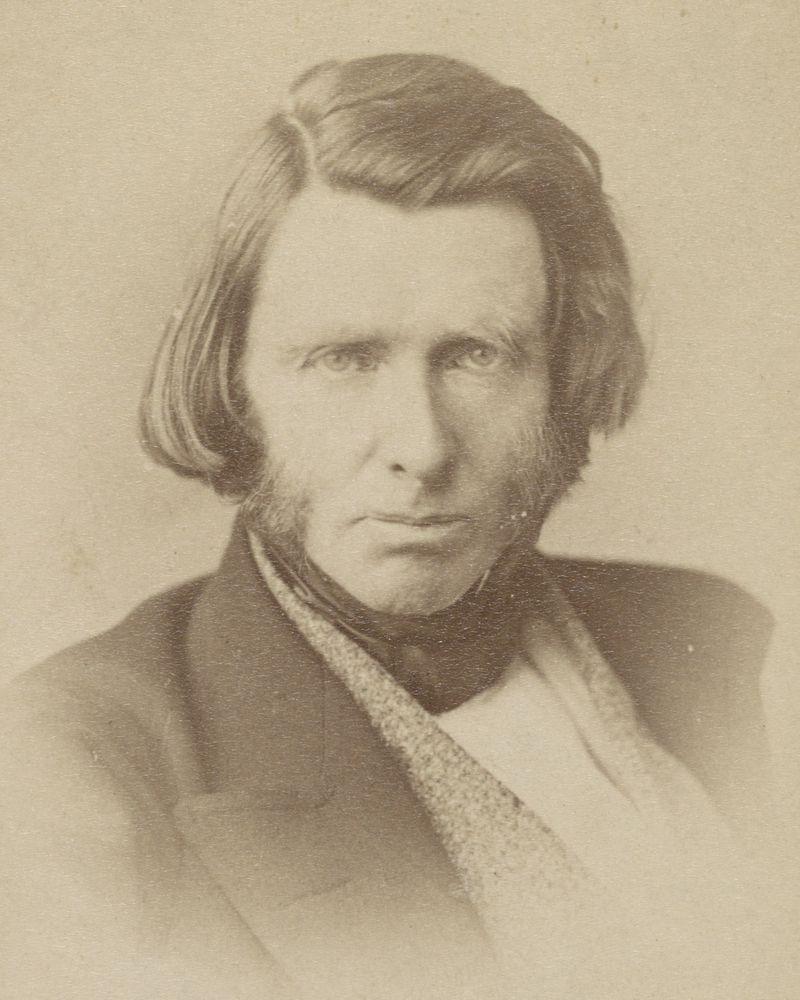
Author
John Ruskin
- Lived
- Lived 1819 to 1900
- From
- From English
- Born in
- Born in London, England
Born on 8 February 1819 at 54 Hunter Street, Brunswick Square, London, the only child of John James Ruskin, a prosperous sherry importer, and Margaret Cock, his first cousin, John Ruskin was taught at home, raised on daily readings of the Bible with his mother, and taken by his parents on long carriage tours of Britain and the Continent. He went up to Christ Church, Oxford, in 1837 and won the Newdigate Prize for poetry in 1839. In 1843, writing anonymously as "A Graduate of Oxford", he published the first volume of Modern Painters, a defence of J. M. W. Turner that grew over seventeen years into five volumes and made him the leading art critic in England. The Seven Lamps of Architecture (1849) and The Stones of Venice (1851 to 1853), with its chapter "The Nature of Gothic", argued that a building shows the moral life of the people who made it. In 1848 he married Euphemia Gray; the marriage was never consummated, and in July 1854 it was annulled at her petition, after which she married the painter John Everett Millais. In 1860 he turned to economics: the four essays of Unto This Last, serialised in the Cornhill Magazine until readers' protests ended the series, attacked the political economy of his day and declared that "there is no wealth but life". He became the first Slade Professor of Fine Art at Oxford in 1869, began the monthly letters of Fors Clavigera to the working men of England in 1871, founded the Guild of St George, and in the same year bought Brantwood, a house on Coniston Water in the Lake District. From 1878 he suffered repeated attacks of mental illness, deepened by grief for Rose La Touche, whom he had loved for years and who died in 1875. After writing his autobiography, Praeterita (1885 to 1889), he fell silent, and he died at Brantwood on 20 January 1900, at the age of eighty.
In 1874 Ruskin led a band of Oxford undergraduates out to North Hinksey to mend a sodden village road, so they might learn the worth of labour. Oscar Wilde and Arnold Toynbee were among the diggers. Wilde remembered Ruskin working beside them in the mist and mud, and the road ending abruptly in the middle of the swamp.
The first button needs the app on this device; the second gets it there.
In the canon
- The Seven Lamps Of Architecture1849
- The Stones Of Venice1851
- Unto This Last1862