
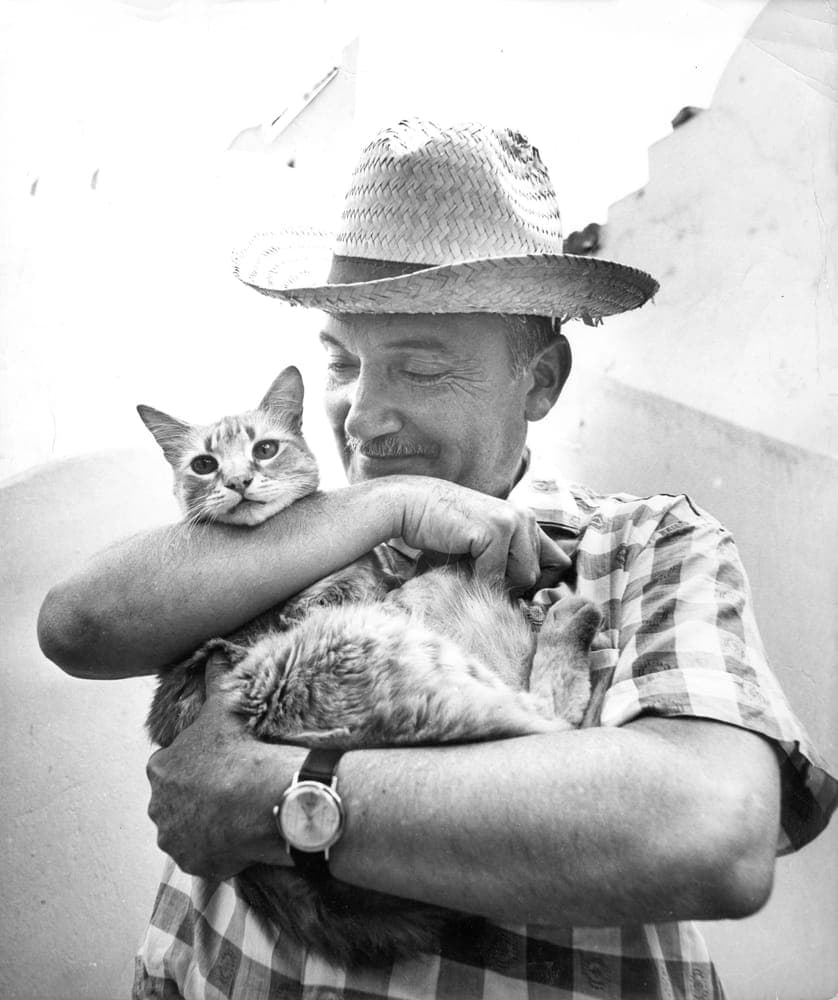
Author
José María Arguedas
- Lived
- Lived 1911 to 1969
- From
- From Peruvian
- Born in
- Born in Andahuaylas, Peru
Born José María Arguedas Altamirano on 18 January 1911 in Andahuaylas, in the southern Peruvian Andes, he was the son of Víctor Manuel Arguedas Arellano, a lawyer from Cuzco who worked as a judge, and Victoria Altamirano Navarro, who died when he was a small child. His father remarried and travelled constantly for work, and the boy grew up in his stepmother's house at San Juan de Lucanas, where, by his own account, he was sent to the kitchen and found his shelter among the Quechua servants. Quechua was the language of his childhood, and the Andean world he learned there became the whole subject of his writing. He followed his father through the towns of the sierra, boarded at a religious school in Abancay in 1924 and 1925, and entered the University of San Marcos in Lima in 1931. His first stories, Agua, appeared in 1935. In 1937 he was arrested for protesting the visit of a general from Fascist Italy and spent most of a year in El Sexto prison, where he worked on the translations of Quechua songs published as Canto kechwa (1938). He married Celia Bustamante in 1939. Yawar Fiesta (1941) was his first novel; Deep Rivers (1958), the story of a boy at a boarding school in Abancay, carried his work across the continent, and was followed by El Sexto (1961) and the vast Todas las sangres (1964). Alongside the fiction he became an ethnologist, taking his doctorate in 1963, directing the Casa de la Cultura and the National Museum of History, and translating the Quechua manuscript of Huarochirí into Spanish. He suffered from depression for much of his adult life and first attempted suicide in 1966. He married Sybila Arredondo in 1967, and in 1968, receiving the Inca Garcilaso de la Vega prize, he gave the speech No soy un aculturado, a declaration that he belonged to both of Peru's cultures at once. He died in Lima on 2 December 1969, and his last novel, The Fox from Up Above and the Fox from Down Below, was published unfinished in 1971.
On 23 June 1965 the Instituto de Estudios Peruanos held a round table in Lima on Todas las sangres, and Arguedas sat with the critics and social scientists who examined it. Some gently and some bluntly, all of them said the caste-bound highlands of his novel no longer existed. That night he wrote that his strength had declined beyond repair.
The first button needs the app on this device; the second gets it there.
In the canon
- Deep Rivers1958