

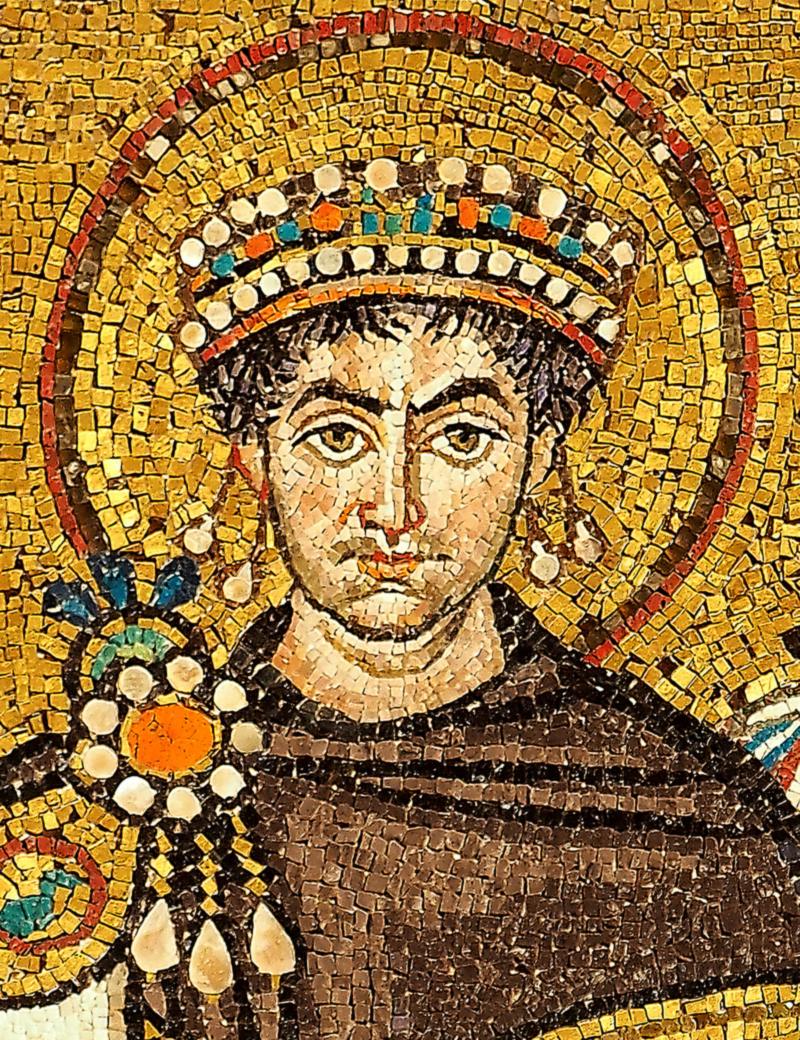
Author
Justinian
- Lived
- Lived 482 CE to 565 CE
- From
- From Roman
- Born in
- Born in Tauresium, Dardania (near Skopje, North Macedonia)
Born around 482 in the hamlet of Tauresium, near the fortress of Bederiana in the Latin-speaking Balkan province of Dardania, Petrus Sabbatius came of a peasant family; his mother, Vigilantia, was the sister of a soldier named Justin. Justin rose through the palace guard at Constantinople, brought the boy to the capital, had him educated in law, theology and Roman history, and adopted him, which is where the name Justinianus comes from. When the emperor Anastasius died in 518, Justin took the throne with his nephew at his side as his closest adviser; Justinian was consul in 521, was made caesar in 525, was crowned co-emperor on 1 April 527 and ruled alone from Justin's death that August. Around 525 he married Theodora, a former actress some twenty years younger, whose nerve helped him keep the throne when the Nika riots burned the capital in January 532. His reign was one of restless and costly ambition. His generals Belisarius and Narses won back North Africa from the Vandals and, after some twenty years of war, Italy from the Ostrogoths; the plague that reached Constantinople in 542 struck the emperor himself; and his builders raised the Hagia Sophia, dedicated in December 537. His most lasting work was the law, which he commissioned rather than wrote: his quaestor Tribonian led the commissions that produced the Codex of imperial constitutions in 529 and again in 534; the Digest, fifty books of excerpts from the classical jurists, ordered on 15 December 530 and confirmed on 16 December 533; the Institutes, a textbook for students; and the Novels, his own later laws, most of them in Greek. Theodora died in 548, and his last years turned towards theology and the defence of what had been won. He died in Constantinople on 14 November 565, childless, at about eighty-three, and was succeeded by his nephew Justin II. Recovered in Italy late in the eleventh century and taught at Bologna, the Digest became the foundation of the civil law of continental Europe.
In January 532 the Blue and Green factions of the Hippodrome turned on him together, burned much of Constantinople and proclaimed a rival emperor, Hypatius. Ships stood ready to carry Justinian away. Procopius records that Theodora refused to flee, and the council held. Belisarius and Mundus then trapped the crowd inside the Hippodrome, where some thirty thousand died.
The first button needs the app on this device; the second gets it there.
In the canon
- The Digest of Roman Law533 CE