

Author
Kabir
- Lived
- Lived 1440 to 1518
- From
- From Indian
- Born in
- Born in Varanasi, India
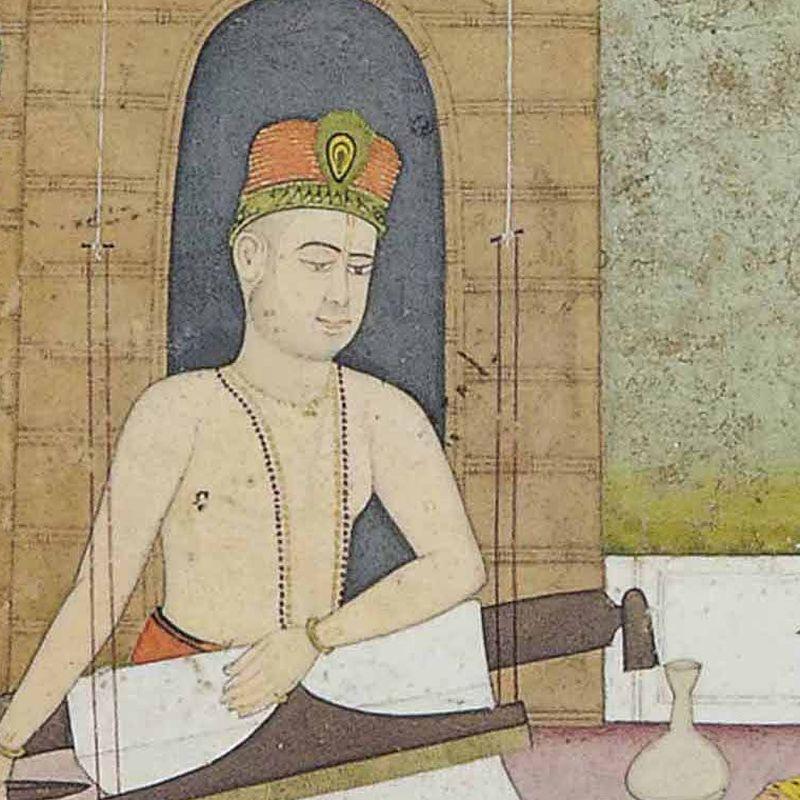
Kabir was born in or near Benares, the holy city now called Varanasi, and almost everything else about his life comes down as story rather than record. Tradition puts his birth in 1398, which would have him living to about 120; most modern accounts, Britannica and the scholar David Lorenzen among them, place his life between about 1440 and 1518, and those are the years given here, though some historians argue instead for 1398 to 1448. He grew up among the julahas, the Muslim weavers of the city, and in his own verses he calls himself a julaha and a kori, both words for a weaver of low caste. A popular legend makes him the abandoned son of a Brahmin widow, found beside the Lahartara pond by a weaver named Niru and his wife Nima, who raised him. He is remembered as a disciple of the Hindu teacher Ramananda, though that link rests on tradition, and he is remembered too as unlettered. He worked at the loom all his life and composed aloud, in the plain speech of north India, short couplets and sung verses that mocked the rituals of Brahmins and mullahs alike and placed God within the breath of every person. Legend says his attacks on both faiths brought him before the Sultan Sikandar Lodi and into exile from Benares. He died at Maghar, near Gorakhpur, in about 1518, choosing by tradition a town where death was said to bring a poor rebirth over the holy city where it was said to bring release. His songs travelled by mouth for generations and survive in three great collections: the Bijak of the Kabir Panth, the community that claims him as its founder; the Kabir Granthavali of Rajasthan; and the Guru Granth Sahib, the Sikh scripture compiled in 1604. Rabindranath Tagore's English versions, Songs of Kabir (1915), carried him to readers in the West.
The best-known story of his youth is a legend, not a record. Knowing the Hindu teacher Ramananda would not take a Muslim weaver as his pupil, the boy lay on the bathing steps of the Ganges at Benares. Ramananda came down to the river, trod on him and cried out "Ram! Ram!", and Kabir claimed those words as his initiation.
The first button needs the app on this device; the second gets it there.
In the canon
- The Weaver's Songs1500