

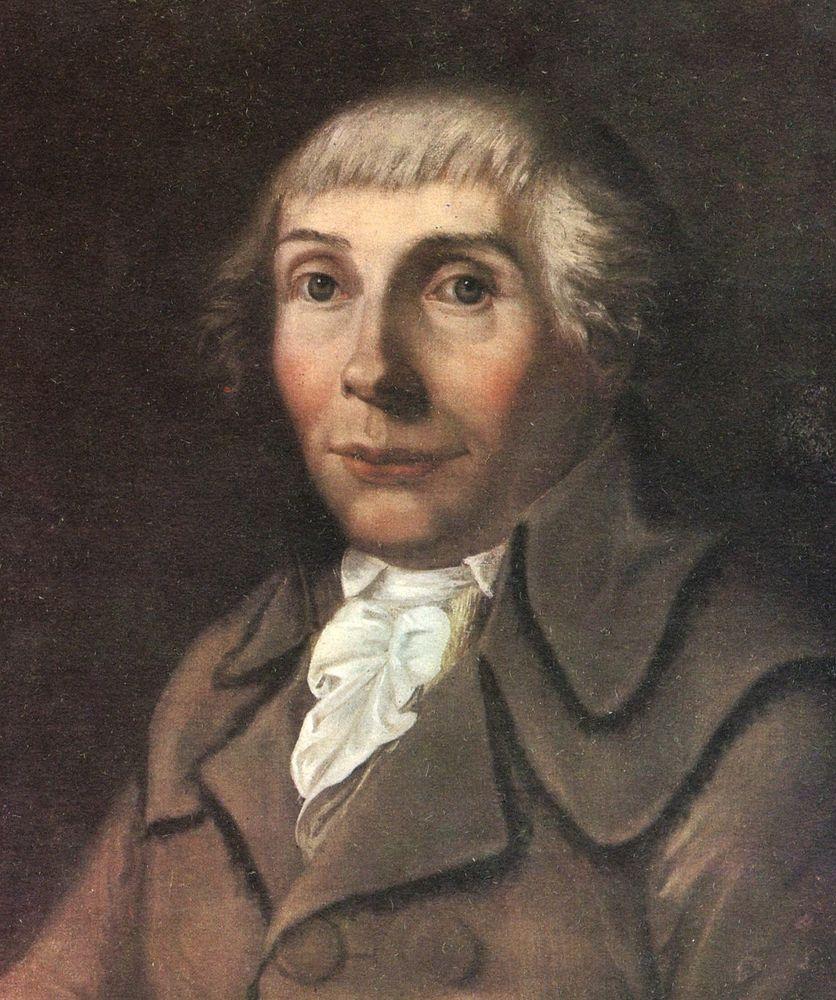
Author
Karl Philipp Moritz
- Lived
- Lived 1756 to 1793
- From
- From German
- Born in
- Born in Hameln, Germany
Born on 15 September 1756 in Hameln, in the Electorate of Hanover, Karl Philipp Moritz grew up poor in a household ruled by religion: his father, a military musician, was a devoted follower of the Quietist Johann Friedrich von Fleischbein, and the boy was raised on self-denial and the mystical writings of Madame Guyon. He was apprenticed to a hatmaker in Braunschweig, an apprenticeship that ended because of the unbearable treatment he received there. A pastor who noticed his gifts found him a benefactor, and from 1771 he attended the grammar school in Hanover, though he kept running after the stage and failed in several attempts to become an actor. He enrolled to study theology at Erfurt in 1776, and in 1778 became a teacher at the military orphanage in Potsdam and then at the Gymnasium zum Grauen Kloster in Berlin. In the summer of 1782 he toured England, much of it on foot, and his letters home, published in 1783 as Journeys of a German in England, remain one of the liveliest foreign accounts of Georgian England. The following year he founded the Magazin zur Erfahrungsseelenkunde, a journal of empirical psychology he edited until his death, and in 1785 he published the first part of Anton Reiser, a psychological novel drawn so closely from his own unhappy youth that it reads as autobiography; the fourth and last part followed in 1790. In Rome from 1786 he became the close friend of Goethe, and there wrote On the Formative Imitation of the Beautiful (1788), an early statement of the idea that a work of art is complete in itself. After a stay in Weimar, where he taught Duke Carl August English, he returned to Berlin in 1789 as professor of the theory of the fine arts at the Academy of Arts, and in 1791 was elected to the Prussian Academy of Sciences and published his Götterlehre, a mythology for general readers. He died in Berlin on 26 June 1793, aged thirty-six.
In Rome in late 1786 Moritz's horse slipped on the smooth paving and he broke his arm. Goethe, only weeks in the city himself, came to sit by his bed, where Moritz lay for nearly a month and told him stories from his life. Goethe wrote home that he was astonished by how closely they resembled his own.
The first button needs the app on this device; the second gets it there.
In the canon
- Anton Reiser1785