

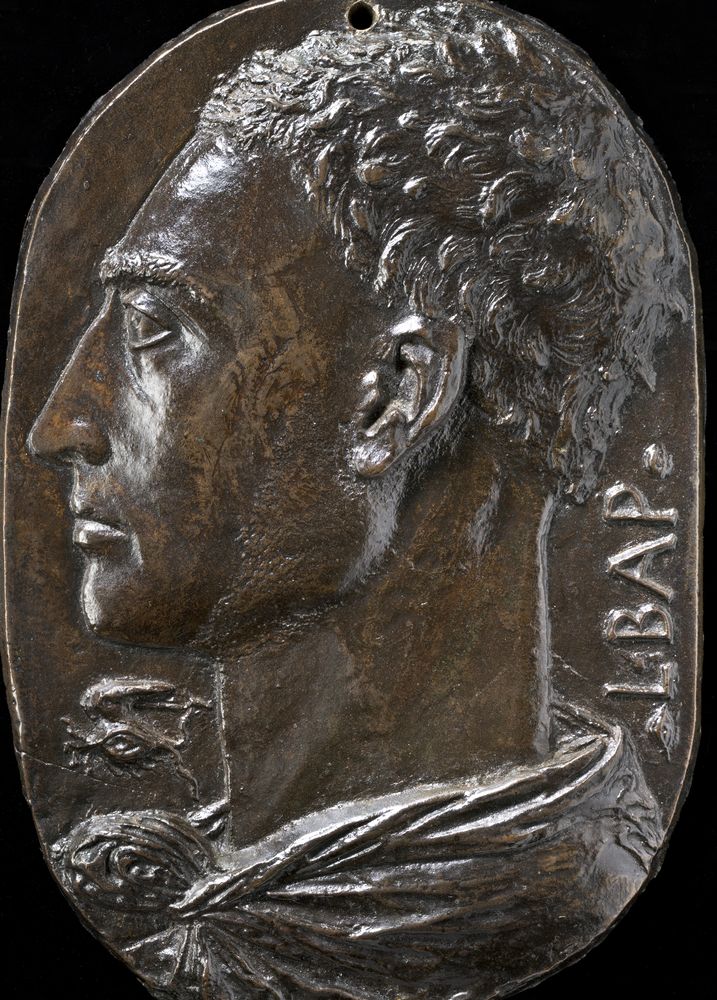
Author
Leon Battista Alberti
- Lived
- Lived 1404 to 1472
- From
- From Italian
- Born in
- Born in Genoa, Italy
Leon Battista Alberti was born in Genoa on 14 February 1404, the second illegitimate son of Lorenzo di Benedetto Alberti, of a great Florentine merchant family then banished from its city, and Bianca Fieschi. He grew up in exile, was schooled at Padua by the humanist Gasparino Barzizza, and went on to study law at Bologna, where his father's death in 1421 left him poor. At twenty he wrote a Latin comedy, Philodoxeos, and in 1428, the year the ban on the Alberti was lifted, he took his degree in canon law. By 1432 he was in Rome as an apostolic abbreviator, drafting papal letters, and a dispensation for his illegitimacy let him take holy orders and live on church benefices for the rest of his life. Following the court of Pope Eugenius IV to Florence in 1434, he found there the new art of Brunelleschi, Donatello and Masaccio, and in 1435 wrote De pictura, the first treatise to set out the geometry of linear perspective for painters; its Italian version of 1436 opens with a tribute to Brunelleschi, whose dome was then being closed over the cathedral. In the same years he wrote the four books Della famiglia, dialogues on the household, marriage and money in the Tuscan vernacular. In the 1440s he measured the ruins of Rome for his Descriptio urbis Romae and wrote the satire Momus, and in 1452 he presented to Pope Nicholas V the ten books De re aedificatoria, the first treatise on architecture since Vitruvius. He designed buildings rather than built them, sending drawings and letters to the masons: the facade of the Palazzo Rucellai and the upper facade of Santa Maria Novella in Florence, the Tempio Malatestiano at Rimini, and the churches of San Sebastiano and Sant'Andrea at Mantua. He wrote besides on sculpture, on the horse, on secret writing and, in a short eulogy, on his dog. He died in Rome in April 1472, aged sixty-eight, with Sant'Andrea barely begun.
His anonymous Latin life, which he very likely wrote himself, describes a small box in which he showed visitors the moon and stars rising over rocky hills at night, and by day wide landscapes of mountains and gulfs, with fleets advancing on the water in shade or in sunshine. Those who saw it took it for a marvel.
The first button needs the app on this device; the second gets it there.
In the canon
- On Painting1435