

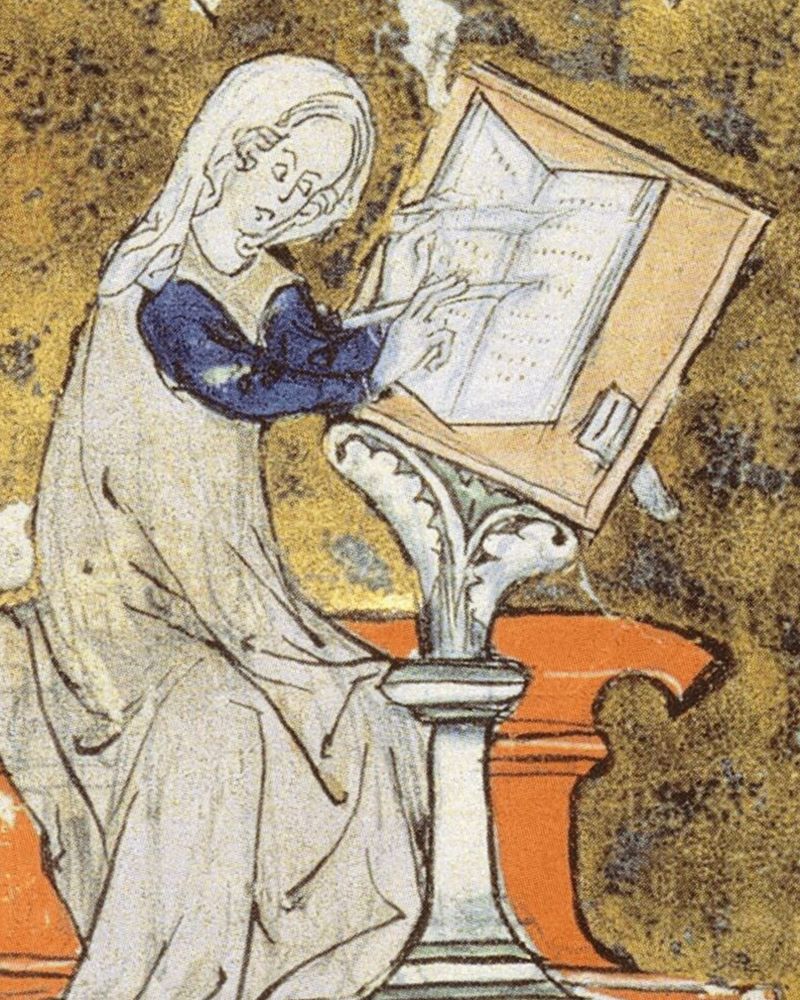
Author
Marie de France
- Lived
- Lived 1160 to 1215
- From
- From French
Everything known about Marie de France comes from her own lines and from one passing remark by another poet. At the close of her Fables she wrote "Marie ai num, si sui de France", my name is Marie and I am from France, and in 1581 the antiquary Claude Fauchet made that line into the name she has carried since. She wrote in French touched by Anglo-Norman, with the odd English word, and she seems to have lived and worked in England in the reign of Henry II, whose court spoke French on both sides of the Channel. Neither her birth nor her death was recorded, so the years given here, 1160 and 1215, are the outer limits scholars set for her writing, not the dates of a life. Her twelve Lais, short tales in rhyming couplets of eight syllables that she said the Bretons had made and she had heard, were dedicated to a "noble king", usually taken to be Henry II, and were probably written in the 1160s or 1170s: Guigemar and the ship with no crew, Bisclavret the werewolf, Lanval and his fairy lover, Laüstic and the dead nightingale, Chevrefoil with Tristan's name cut into a hazel stick, and the long double love of Eliduc. Around 1180 the poet Denis Piramus noted that her lays were not true at all and yet were loved by counts, barons and knights and read aloud to ladies. She went on to put more than a hundred Aesopic fables into French for a Count William, naming King Alfred as her English source, and after about 1189 she turned Henry of Saltrey's Latin account of the Purgatory of Saint Patrick into French verse. A life of Saint Audrey signed by a Marie may also be hers. She has been proposed as Marie, abbess of Shaftesbury and half sister of Henry II, as Marie de Meulan, and as abbesses of Reading and Barking, but every identification is conjecture. The only manuscript that holds all twelve lais with her prologue, British Library Harley 978, was copied in England around 1260.
At the end of her Fables, after more than a hundred tales of wolves, foxes, lions and lambs, Marie stopped to sign the book. She wrote "Marie ai num, si sui de France" and gave her reason: many clerks, she feared, might take her labour as their own, and she would not let anyone else claim it.
The first button needs the app on this device; the second gets it there.
In the canon
- The Lais of Marie de France1170