
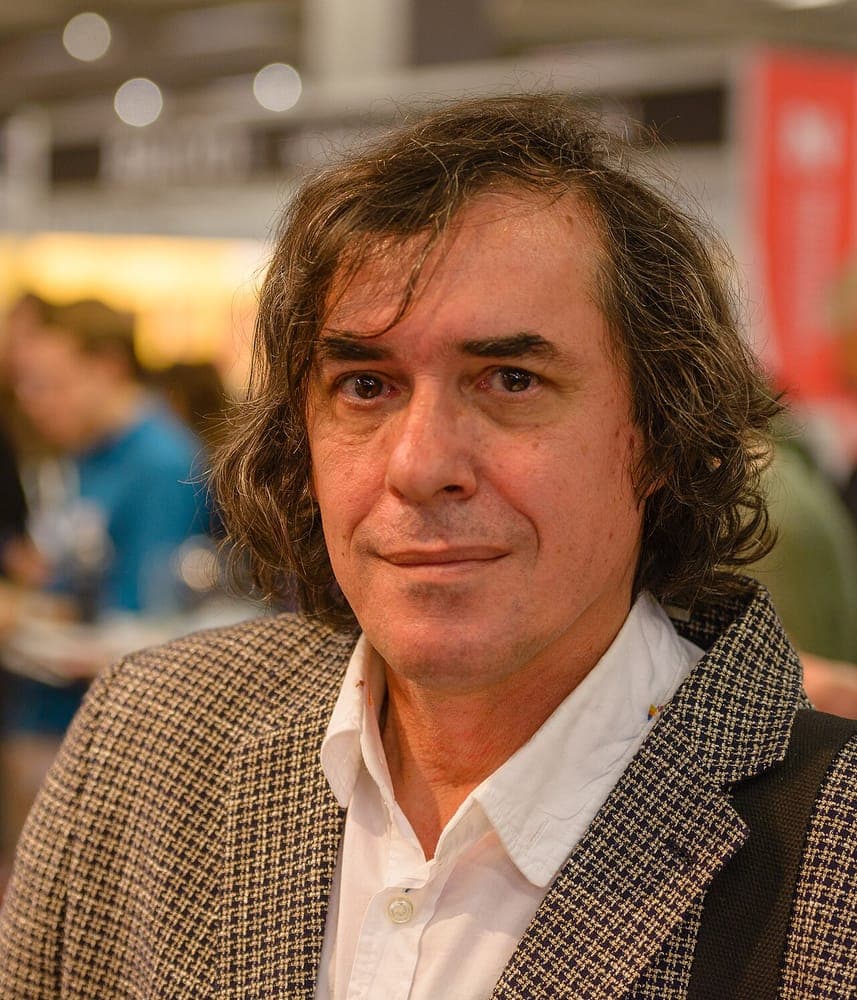
Author
Mircea Cărtărescu
- Lived
- Lived born 1956
- From
- From Romanian
- Born in
- Born in Bucharest, Romania
Born on June 1, 1956, in Bucharest, Mircea Cărtărescu grew up in the concrete apartment blocks of the communist capital, the city that would become the single landscape of nearly everything he wrote. As a teenager at Cantemir Vodă National College he fell for the American counterculture of the 1960s, Bob Dylan, Jimi Hendrix and The Doors, and joined literary circles run by the critics Nicolae Manolescu and Ovid S. Crohmălniceanu. He studied Romanian at the University of Bucharest, published his first poems in 1978 and became one of the leading voices of the Monday Circle, the workshop that gave its name to the generation of the 1980s. His debut collection, Faruri, vitrine, fotografii (1980), won the Writers' Union prize for a first book; his graduation thesis, on the poetic imagination of Mihai Eminescu, was later published as a book of its own. Through the 1980s he taught Romanian at a school while writing The Levant, an epic in twelve cantos that parodies the whole of Romanian poetry and could only appear after the revolution, in 1990. His first prose book, Visul, came out mangled by the censors in 1989 and was restored in full as Nostalgia in 1993. He then spent more than a decade on Orbitor, a three-volume novel of Bucharest, dreams and the body published between 1996 and 2007 and translated into English as Blinding, which Romanian critics voted the novel of the decade. Solenoid (2015), the vast diary of a frustrated writer turned Bucharest schoolteacher, won the Dublin Literary Award in 2024 in Sean Cotter's translation. Teaching at the University of Bucharest since 1991, translated into more than twenty-five languages and named for years among the favourites for the Nobel Prize, he is married to the poet Ioana Nicolaie.
When his first prose book appeared in 1989, the censors had been through it. They removed the opening story, The Roulette Player, renamed The Architect as The Organist, and refused his title, Nostalgia, because it recalled Nostalghia, the film of the émigré director Andrei Tarkovsky. It appeared as Visul, The Dream, and returned whole under its own name in 1993.
The first button needs the app on this device; the second gets it there.
In the canon
- Nostalgia1989
- Blinding1996
- Solenoid2015