

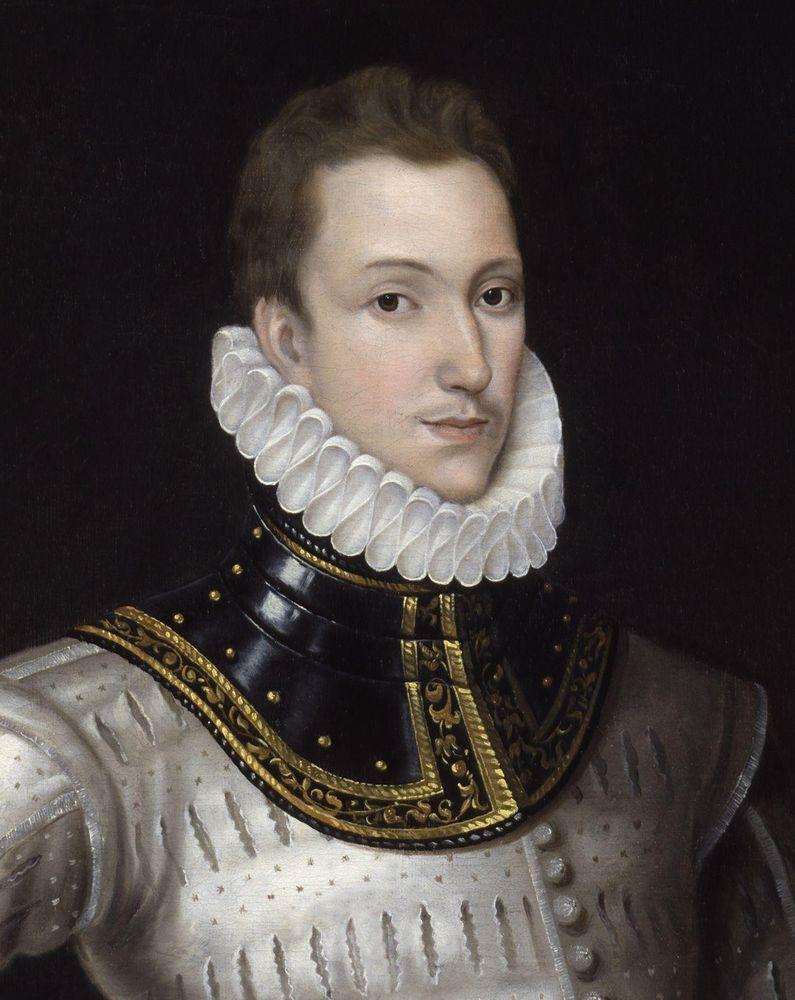
Author
Philip Sidney
- Lived
- Lived 1554 to 1586
- From
- From English
- Born in
- Born in Penshurst, England
Philip Sidney was born on 30 November 1554 at Penshurst Place in Kent, the eldest son of Sir Henry Sidney, later Lord Deputy of Ireland, and of Mary Dudley, sister of Robert Dudley, Earl of Leicester; he was named for his godfather, Philip II of Spain. He entered Shrewsbury School in 1564 alongside Fulke Greville, his lifelong friend and later his biographer, and went on to Christ Church, Oxford, which he left without a degree. In 1572 he set out on three years of travel on the Continent and was in Paris, lodged with the English ambassador Sir Francis Walsingham, during the St Bartholomew's Day massacre; abroad he also met the Huguenot scholar Hubert Languet, who became his mentor and his most faithful correspondent. Elizabeth sent him as ambassador to the new Emperor Rudolf II in 1577, but his ardent Protestant politics made her wary of him, and in 1579, after a quarrel with the Earl of Oxford and a letter urging the Queen against her proposed marriage to the Duke of Anjou, he withdrew from court. At Wilton, the house of his sister Mary, Countess of Pembroke, he wrote the first version of the prose romance The Countess of Pembroke's Arcadia, and in the same years he wrote The Defence of Poesy, the first great work of English literary criticism, and the sonnet sequence Astrophil and Stella, addressed to Penelope Devereux. None of it was printed in his lifetime. He was knighted in January 1583 and that year married Walsingham's daughter Frances. In 1585 he was made governor of Flushing in the Netherlands, where England had gone to war against Spain. On 22 September 1586, charging the Spanish lines at Zutphen, he was shot in the thigh above the knee; the wound turned gangrenous, and he died at Arnhem on 17 October 1586, aged thirty-one. His funeral at St Paul's in February 1587 was one of the grandest London had seen, and his books, printed in the decade that followed, made him the pattern of the Elizabethan poet-courtier.
Fulke Greville, writing his friend's life a quarter of a century later, told the story that made Sidney a legend. Carried from the field at Zutphen with his thigh shattered and thirsty from loss of blood, Sidney was handed a bottle, saw a dying soldier gazing at it, and gave it to him: 'Thy necessity is yet greater than mine.'
The first button needs the app on this device; the second gets it there.
In the canon
- The Countess of Pembroke's Arcadia1590
- The Defence of Poesy1595