

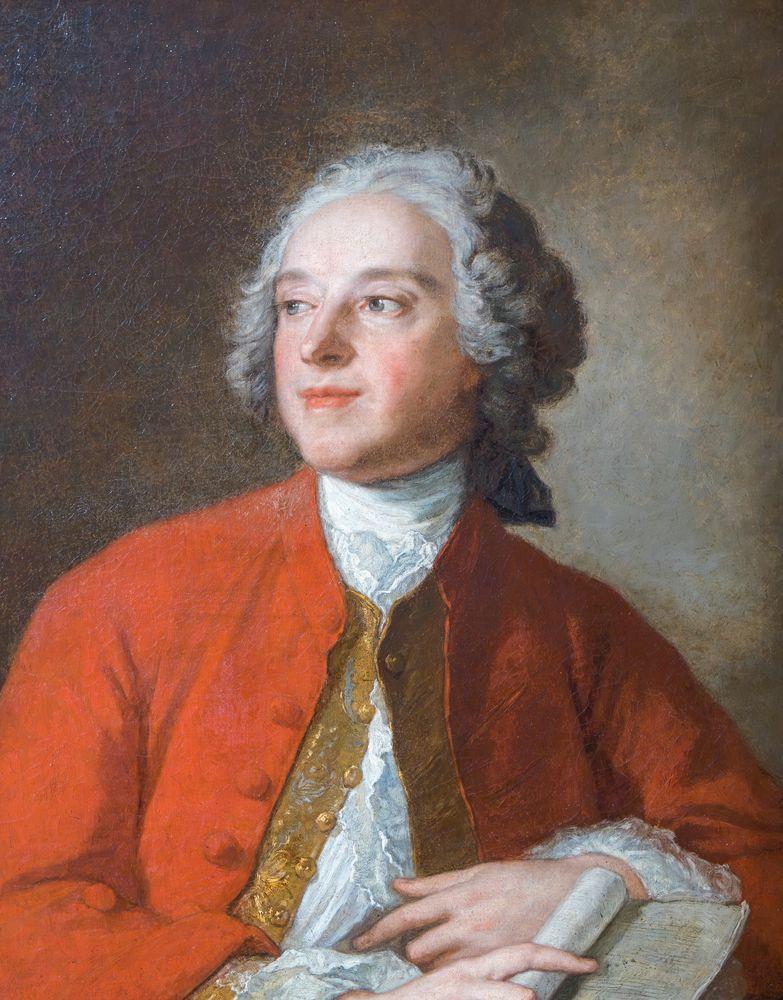
Author
Pierre Beaumarchais
- Lived
- Lived 1732 to 1799
- From
- From French
- Born in
- Born in Paris, France
Born Pierre-Augustin Caron on January 24, 1732, in the rue Saint-Denis in Paris, the only son among the children of André-Charles Caron, a watchmaker, he left school at twelve to learn his father's trade. At twenty-one he invented a new escapement for watches, and when the royal clockmaker Jean-André Lepaute claimed it, the Academy of Sciences found for the young man in 1754. The case took him to Versailles, where he made watches for the court, taught the harp to the daughters of Louis XV, and in 1756 married a widow whose small estate, le Bois Marchais, gave him the name Beaumarchais. She died within a year; a second wife, Geneviève-Madeleine Lévêque, died in 1770. In 1764 and 1765 he spent ten months in Madrid, ostensibly to defend his sister Lisette against the faithless José Clavijo, an episode Goethe later dramatised as Clavigo. His first plays, the sentimental dramas Eugénie (1767) and Les Deux Amis (1770), made little stir. Ruin came with a lawsuit over the estate of the financier Pâris-Duverney, and in 1773 and 1774 he turned it into a triumph with his Mémoires against the judge Goezman, pamphlets so witty that all Paris took his side. The Barber of Seville followed in 1775, and from 1776 he ran a trading house, Roderigue Hortalez et Cie, that shipped French arms to the American rebels. Louis XVI banned The Marriage of Figaro after a private reading, but it opened at the Comédie-Française on April 27, 1784, to a sensation. He bought Voltaire's manuscripts and published his complete works at Kehl, married his long-time companion Marie-Thérèse de Willer-Mawlaz in 1786, and finished the trilogy with La Mère coupable (1792). The Revolution jailed him briefly in 1792 and listed him as an émigré; he returned to Paris in 1796 and died there on May 18, 1799, at sixty-seven.
Let out of prison under guard in 1773 to plead his case, Beaumarchais could not reach the judge, Goezman. The way in, he was told, was a present to the judge's wife: a hundred louis, a diamond-set watch, and fifteen louis for a secretary. He lost; she returned all but the fifteen louis, and over those he went to war.
The first button needs the app on this device; the second gets it there.
In the canon
- The Barber of Seville1775
- The Marriage of Figaro1784