

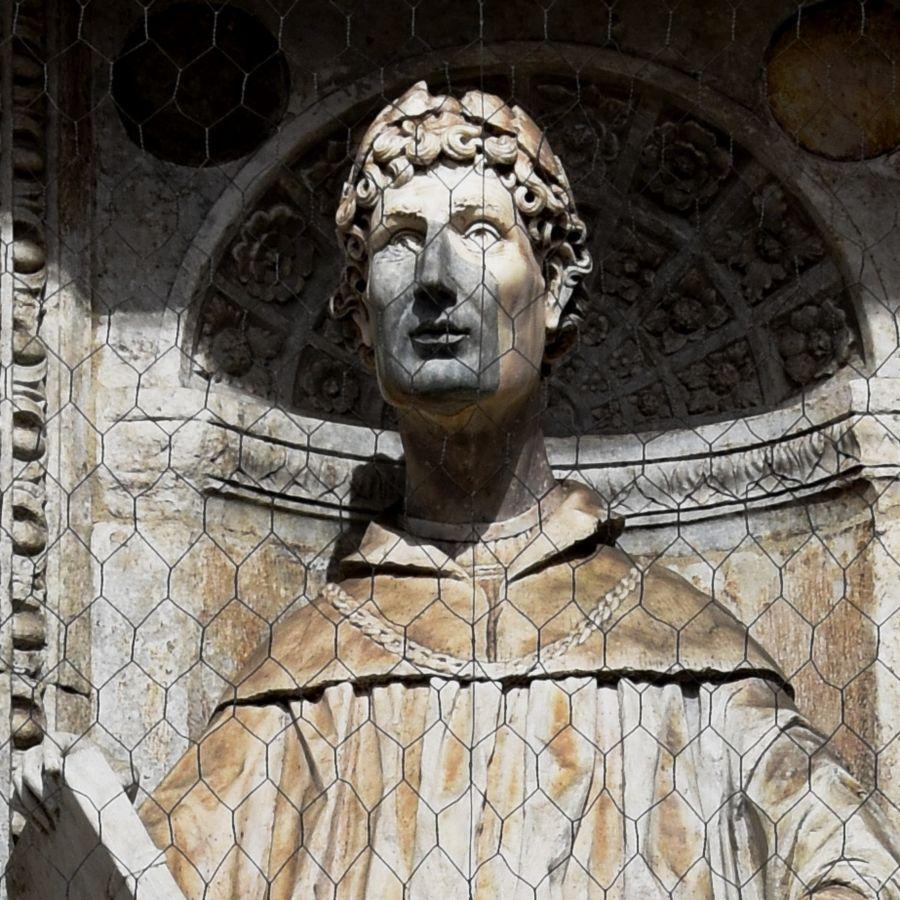
Author
Pliny the Younger
- Lived
- Lived 61 CE to 113 CE
- From
- From Roman
- Born in
- Born in Como, Italy
Pliny the Younger was born Gaius Caecilius Cilo in 61 or 62 CE at Novum Comum, the modern Como, at the southern end of Lake Como, the son of Lucius Caecilius Cilo, a landowner of the town, and Plinia Marcella, sister of the naturalist Pliny the Elder. His father died when he was a boy, and the old general Lucius Verginius Rufus became his guardian. He studied rhetoric in Rome under Quintilian and the Greek teacher Nicetes Sacerdos, and at fourteen wrote a tragedy in Greek. In August 79 he was staying with his uncle at Misenum when Vesuvius erupted across the bay; the elder Pliny sailed to help and died on the shore at Stabiae, and his will adopted his seventeen-year-old nephew, who took the name Gaius Plinius Caecilius Secundus. He made his name as an advocate in the centumviral court, served as a military tribune with the Third Gallic legion in Syria, and climbed the senatorial ladder under Domitian: quaestor around 89, tribune of the people in 91, praetor in 93, then prefect of the military treasury. Under Nerva and Trajan he ran the treasury of Saturn, and in September 100 he served as suffect consul, thanking the emperor in the speech he later expanded as the Panegyricus. With his friend Tacitus he prosecuted Marius Priscus, governor of Africa, for extortion and won. He became an augur and curator of the bed and banks of the Tiber, and married three times, last to Calpurnia, a young woman from Comum. He gathered his private letters into nine books, finished portraits of Roman life addressed to friends who included Tacitus and Suetonius. Around 110 Trajan sent him to govern Bithynia and Pontus, and his official correspondence with the emperor became a tenth book, which holds the earliest surviving Roman account of Christian worship. To Comum he gave a library, a fund for the upkeep of freeborn children and, by his will, public baths. He died, probably still in Bithynia, around 113.
On the night after his uncle sailed toward Vesuvius, the earth at Misenum shook so hard that his mother ran to wake him. Pliny, seventeen, sat out in the courtyard, called for a volume of Livy and went on making extracts, until a Spanish friend of his uncle scolded them both for sitting still. His uncle never came home.
The first button needs the app on this device; the second gets it there.
In the canon
- The Letters of the Younger Pliny100 CE