

Author
Plotinus
- Lived
- Lived 205 CE to 270 CE
- From
- From Greek
- Born in
- Born in Lycopolis, Egypt
Plotinus was born around 205 CE in Roman Egypt, at Lycopolis according to the later writer Eunapius, though his own pupil and biographer Porphyry could learn nothing of it: Plotinus seemed ashamed of being in the body and would speak of neither his parents, his people nor his birthplace, and never told anyone the day he was born. At twenty-seven he was seized by a passion for philosophy, sat through the lecturers of Alexandria without satisfaction, and was taken by a friend to hear Ammonius Saccas, a teacher who left no writings. "This was the man I was looking for," he said, and he stayed eleven years. Eager to learn the philosophy of the Persians and the Indians, he joined the emperor Gordian III's campaign against Persia, and when Gordian was killed in Mesopotamia in 244 he escaped with difficulty to Antioch. At forty, in the reign of Philip the Arab, he settled in Rome, where he taught for the rest of his life in a circle that took in senators, physicians and a poet, and where dying parents of rank left their children and their property in his care. He wrote nothing until the first year of the emperor Gallienus, around 254, and then set his lectures down as treatises: there were twenty-one when the young Porphyry arrived in 263, and fifty-four by the end. He asked Gallienus and the empress Salonina to rebuild a ruined town in Campania as Platonopolis, a city to live under Plato's laws, but courtiers talked the emperor out of it. Worn down by a disfiguring illness, he withdrew to a friend's estate in Campania and died there in 270, at sixty-six. Some thirty years later Porphyry edited the treatises into six sets of nine, the Enneads, and through them Plotinus, the founder of what is now called Neoplatonism, passed to Augustine, to the Florentine Platonists of the Renaissance and to the poets who came after.
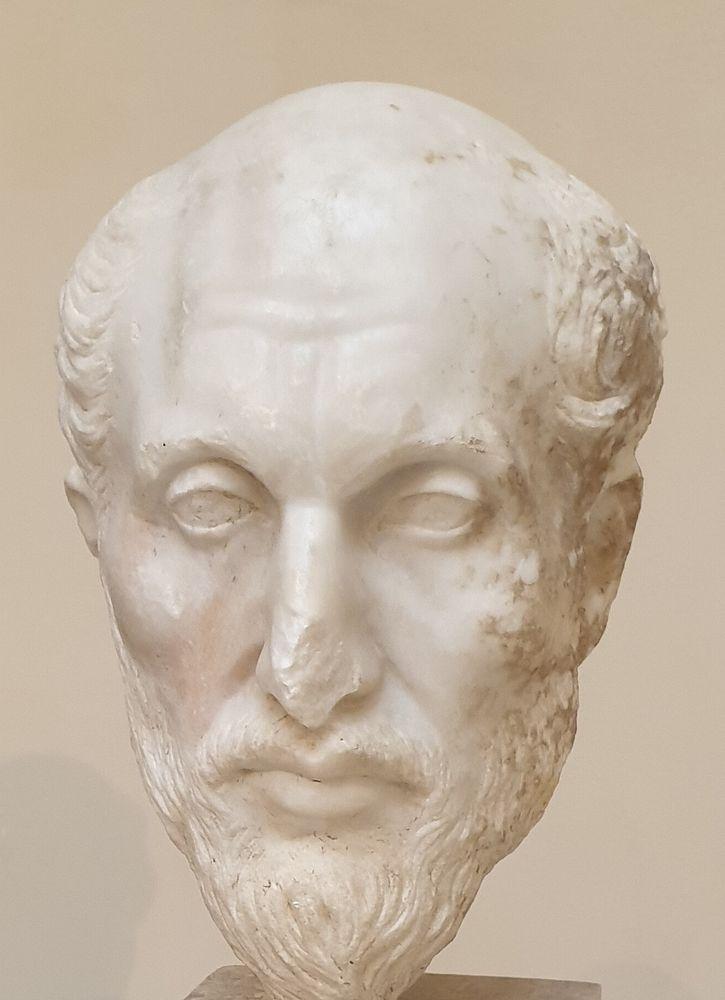
Plotinus refused to sit for a portrait, asking his pupil Amelius whether it was not enough to carry about the image in which nature had enclosed him. So Amelius brought the painter Carterius to the lectures, where he studied the master's face without his knowledge, drew it afterwards from memory, and let Amelius correct the likeness.
I have been a long time waiting for you; I am striving to give back the Divine in myself to the Divine in the All.
The first button needs the app on this device; the second gets it there.
In the canon
- The Enneads270 CE