

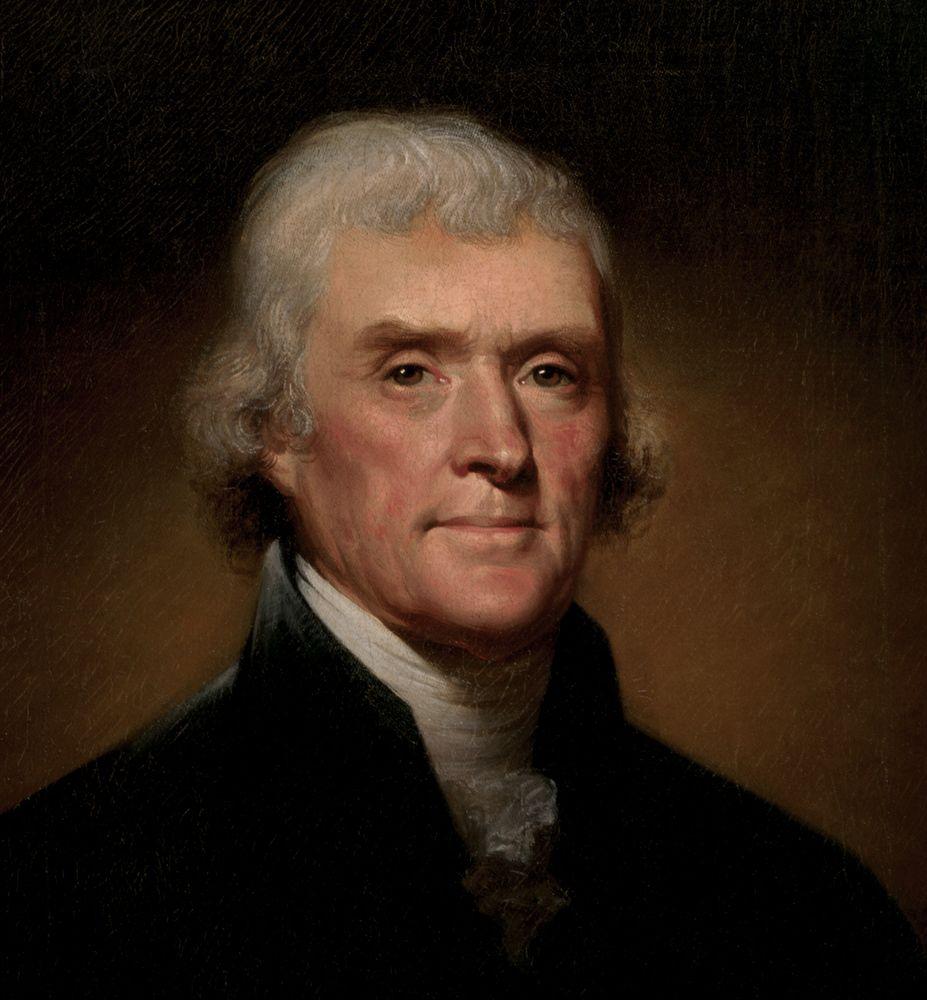
Author
Thomas Jefferson
- Lived
- Lived 1743 to 1826
- From
- From American
- Born in
- Born in Shadwell, Virginia
Born on April 13, 1743, at Shadwell in the Virginia Piedmont, the son of the surveyor and planter Peter Jefferson, Thomas Jefferson lost his father at fourteen, studied at the College of William & Mary, read law under George Wythe and was admitted to the bar in 1767. He sat in the House of Burgesses from 1769, began building Monticello on a mountaintop above Charlottesville, and in 1772 married Martha Wayles Skelton, who died ten years later having borne six children, two of whom reached adulthood. In June 1776, at thirty-three, he drafted the Declaration of Independence. He wrote the Virginia Statute for Religious Freedom, served as governor of Virginia through the British invasion, and in 1781 began answering a French diplomat's questions about his state; the answers grew into Notes on the State of Virginia, printed privately in Paris in 1785 and publicly in London in 1787, the only full-length book he published. It surveys Virginia's rivers, caves, animals, laws and peoples, rebuts the French naturalist Buffon's claim that life in the New World was degenerate, and holds both his warning on slavery ("I tremble for my country when I reflect that God is just") and his speculation, advanced "as a suspicion only," that Black people were inferior. He was minister to France, the first Secretary of State, Vice President under John Adams and from 1801 to 1809 the third President, doubling the country with the Louisiana Purchase. Over his life he enslaved more than six hundred people, and he freed ten. The Thomas Jefferson Foundation, which runs Monticello, concluded in 2000 and stated without qualification in 2018 that he fathered six children with Sally Hemings, an enslaved woman at Monticello, in a relationship that by her son Madison's account began in Paris when she was a teenager; four of the children survived, and all four went free. In retirement he founded the University of Virginia. He died at Monticello on July 4, 1826, fifty years to the day after the Declaration was adopted.
In June 1781, days after his term as governor ended, British cavalry under Banastre Tarleton rode up to Monticello to take him, and he got away. The Assembly ordered an inquiry into his conduct. He retreated to his Poplar Forest farm, was thrown from his horse, and spent the weeks laid up answering a French diplomat's questions about Virginia.
Is it the Fourth?
The first button needs the app on this device; the second gets it there.
In the canon
- Notes on the State of Virginia1785