
Author
Thomas Malory
- Lived
- Lived 1416 to 1471
- From
- From English
- Born in
- Born in Warwickshire, England
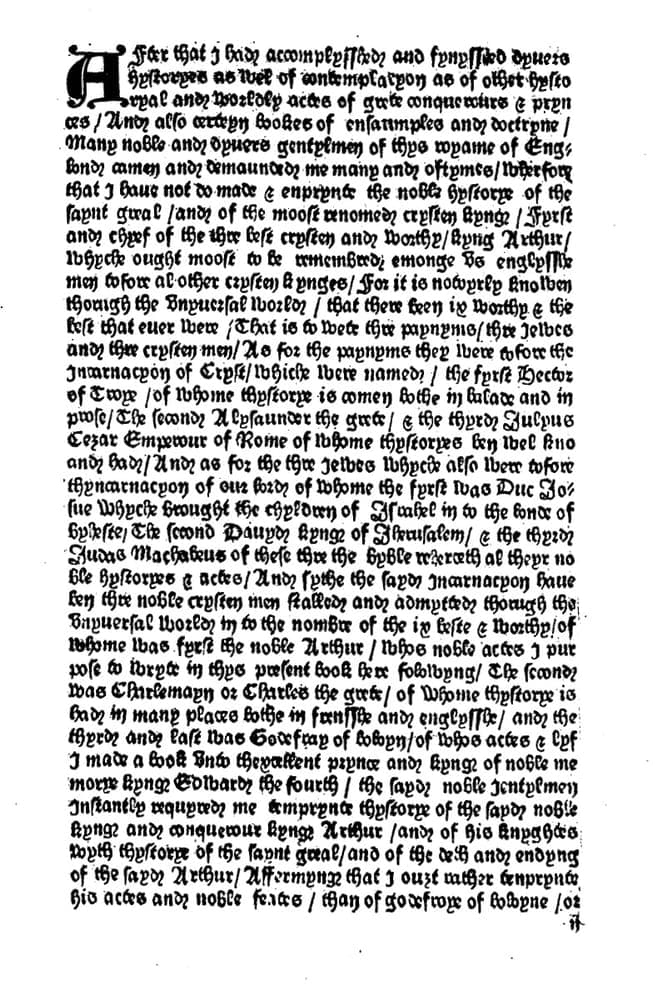
Nothing about Thomas Malory is settled, beginning with which Thomas Malory he was. At least four fifteenth century men of the name have been put forward, and the one most scholars accept is Sir Thomas Malory of Newbold Revel in Warwickshire, born around 1416 into a landed family, knighted before October 1441, and elected knight of the shire for Warwickshire in 1443. On the surface that is an ordinary gentry career. The court rolls tell a different story. From 1450 he was accused of ambushing Humphrey Stafford, Duke of Buckingham, with twenty six other men, of extortion, of cattle raiding, of the rape of a neighbour's wife at Monks Kirby, and of breaking into Combe Abbey by night to rob it before returning the next morning to insult the monks. His arrest was ordered in March 1451 and he was tried at Nuneaton that August, after which he spent most of his remaining twenty years in the Marshalsea, at Colchester, and finally in Newgate, escaping at least twice and excluded by name from four royal pardons. Somewhere inside that confinement he wrote the book, taking the French prose romances, Geoffrey of Monmouth, and two English poems and making one continuous English story out of them: Arthur's begetting, the sword, the Round Table, Lancelot and Guinevere, the Grail, and the last battle. He finished it in the ninth year of Edward IV, between March 1469 and March 1470, and died on 14 March 1471, buried at Greyfriars beside the prison. William Caxton printed it at Westminster on 31 July 1485 under the title Caxton chose, Le Morte d'Arthur, and every English Arthur since, Spenser's and Tennyson's and Twain's and T.H. White's, has come down through him.
He finished the book in prison. At the end of one tale he wrote himself into the page as a knight prisoner, Thomas Malleorre, and asked whoever read it to pray that God send him good deliverance soon and hastily. Caxton dropped those prison tags in 1485, and no reader saw them again until 1934.
The first button needs the app on this device; the second gets it there.
In the canon
- Le Morte d'Arthur1485