

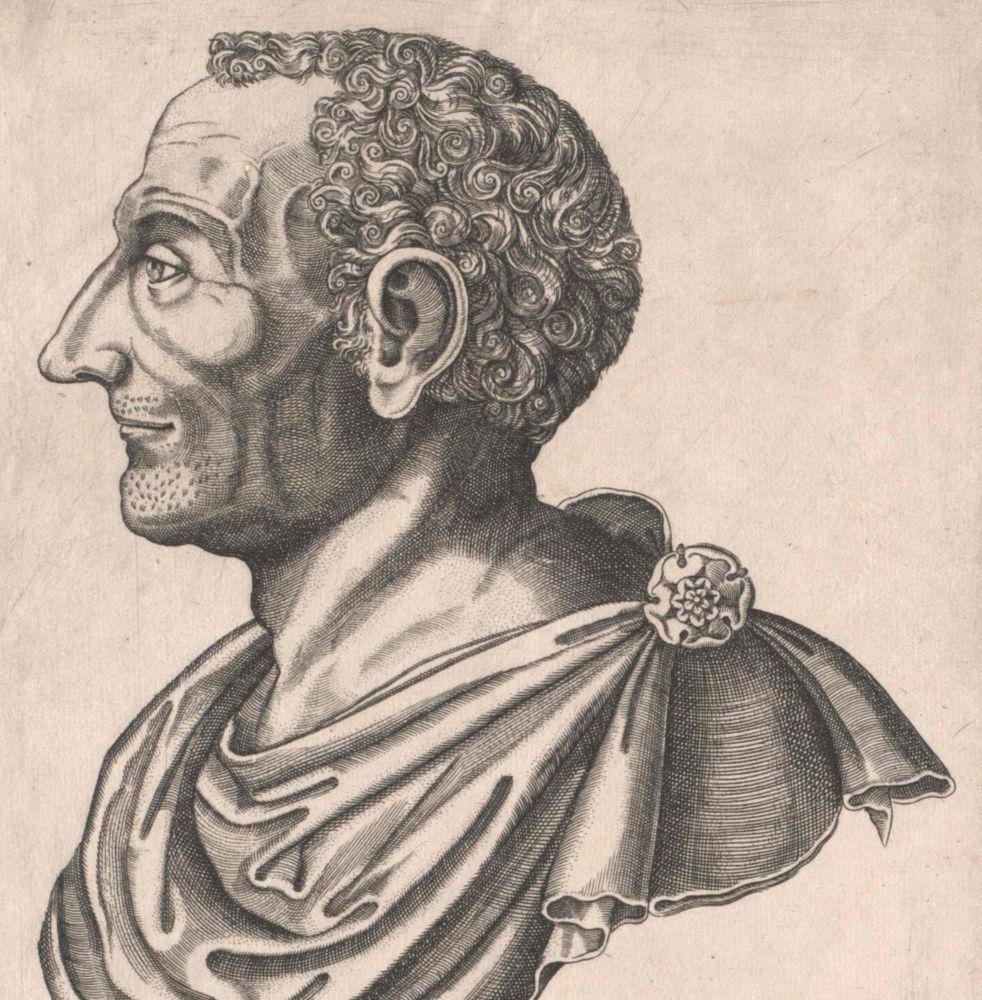
Author
Titus Livy
- Lived
- Lived 59 BCE to 17 CE
- From
- From Roman
- Born in
- Born in Patavium (now Padua), Italy
Titus Livius was born in Patavium, the modern Padua, in 59 BCE by the date Saint Jerome gives in his Chronicle, though some scholars, following G. M. Hirst and Ronald Syme, have argued for 64 BCE. Patavium was among the richest cities of northern Italy, and nothing is known of his family or schooling beyond the fact that he grew up there through the civil wars that ended the Republic. Unlike nearly every other Roman historian, he held no office, led no army and sat in no senate; he appears to have been a man of private means who gave his life to a single work. Around 27 BCE, soon after Octavian took the name Augustus, he brought out the first books of a history of Rome from the founding of the city, Ab Urbe Condita, opening with Aeneas, Romulus and the kings. He kept at it for some forty years, through 142 books that carried the story down to the death of Augustus's stepson Drusus in 9 BCE. He moved in the circle of the court: Suetonius says he encouraged the young Claudius, the future emperor, to write history, while Asinius Pollio sneered at the provincial flavour of his Latin as Patavinitas, the speech of Padua. He married and had at least a son and a daughter, who became the wife of the rhetorician Lucius Magius. He died at Patavium in 17 CE. Only thirty-five of his books survive: the first ten, running from the foundation to 293 BCE, and Books 21 to 45, which tell the war with Hannibal and Rome's advance into Macedonia and the Greek east down to 167 BCE, with short summaries of nearly all the rest. Copied through the Middle Ages, pieced together by Petrarch and argued over by Machiavelli in his Discourses, they shaped the Rome that Europe carried in its head for two thousand years.
In 25 CE the historian Cremutius Cordus stood before Tiberius and the Senate, charged with praising Brutus and Cassius. In his defence he named Livy, who had praised Pompey so warmly that Augustus called him a Pompeian, and yet the two had stayed friends. Cordus went home and starved himself, and the Senate ordered his books burned.
The first button needs the app on this device; the second gets it there.
In the canon
- The Early History of Rome (Books I-V)27 BCE
- Rome and Italy (Books VI-X)25 BCE
- The War with Hannibal (Books XXI-XXX)20 BCE
- Rome and the Mediterranean (Books XXXI-XLV)10 BCE