
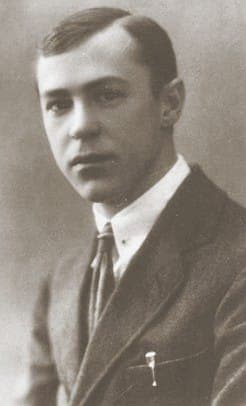
Author
Valerian Pidmohylny
- Lived
- Lived 1901 to 1937
- From
- From Ukrainian
- Born in
- Born in Chapli, Ukraine
Born Valerian Petrovych Pidmohylny on February 2, 1901 (January 20 in the old calendar), in the village of Chapli near Katerynoslav, now Dnipro, in Ukraine, then part of the Russian Empire, he was the son of Petro Pidmohylny, a landless clerk and later cashier on a large estate, and a peasant mother who had no schooling. He learned French as a boy, finished the First Katerynoslav Real School with distinction in 1918, and studied mathematics and then law at Katerynoslav University without graduating, held back by poverty. His first collection of stories appeared in 1920. In 1921 he moved to Kyiv, married Kateryna Chervinska, a priest's daughter from Vorzel and an actress, and taught at the labour school in Vorzel through the famine years. Back in Kyiv he joined the Lanka group, later renamed MARS, alongside Yevhen Pluzhnyk and Hryhorii Kosynka, worked as an editor at the Knyhospilka publishing house and co-edited the journal Zhyttia i revoliutsiia. He became one of the leading Ukrainian translators of French literature, editing and translating multi-volume editions of Maupassant and Anatole France and rendering Balzac, Stendhal, Flaubert, Voltaire and Diderot. His novel The City (1928), the story of Stepan Radchenko, a village youth who comes to Kyiv to study and ends by seeing himself as its master, is counted the first urban novel in Ukrainian literature, and A Little Drama (1930) carried his psychological, existential prose further. Removed from the journal's board in 1930, he was seldom published afterwards. Arrested in Kyiv on December 8, 1934, and accused of belonging to a terrorist group of nationalist writers, he was sentenced in March 1935 to ten years and sent to the Solovki camp, where he went on writing a novel about the start of collectivization. On November 3, 1937, he was shot at Sandarmokh in Karelia, one of the generation Ukrainians call the Executed Renaissance. He was rehabilitated in 1956, and his books, banned until 1989, have returned to print.
Taken by the NKVD in December 1934, Pidmohylny denied the charges at every interrogation and wrote a statement calling them false and slanderous. On 11 January 1935 a protocol recorded his confession to membership of a group of seventeen writers with terrorist intentions. Eight days later he told his interrogators he belonged to no organization at all.
The first button needs the app on this device; the second gets it there.
In the canon
- The City1928