
Author
William Blake
- Lived
- Lived 1757 to 1827
- From
- From English
- Born in
- Born in Soho, London, England
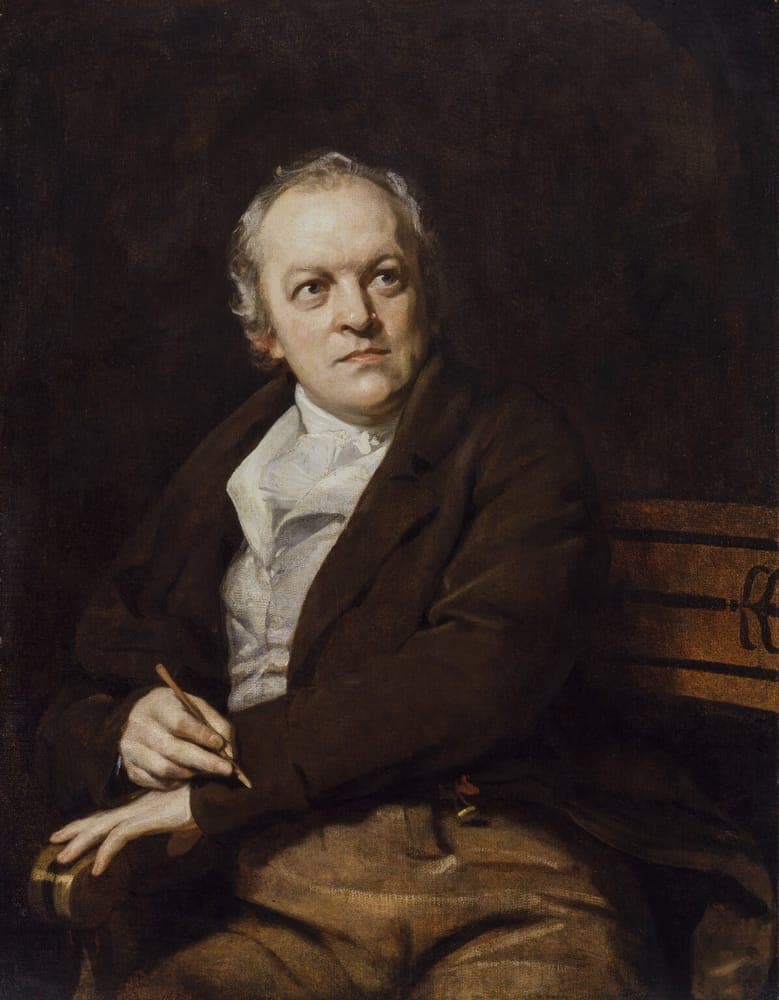
William Blake was born on November 28, 1757, at 28 Broad Street in Soho, London, the third son of a hosier. He had no formal schooling beyond childhood, but from the age of eight he reported visions: a tree at Peckham Rye filled with angels, their wings bespangling every bough like stars, so vivid his father nearly beat the lie out of him before his mother intervened. In 1772 he was apprenticed for seven years to the engraver James Basire, who sent him to draw the Gothic tombs and effigies of Westminster Abbey, an education in medieval line that marked his art ever after. On August 18, 1782, he married Catherine Boucher, an illiterate market gardener's daughter who signed the register with a mark; he taught her to read, to draw, and to color his plates, and she never left his side. In 1787 his beloved younger brother Robert died of consumption at twenty-four, and Blake said Robert's spirit came to him afterward in a vision and showed him relief etching, the illuminated-printing method by which he wrote, illustrated, engraved, printed, and hand-colored his own books himself. Songs of Innocence appeared in 1789 and, combined five years later with its darker counterpart as Songs of Innocence and of Experience, became the foundation of his reputation. In January 1804 he stood trial for sedition at Chichester, accused by a soldier he had ejected from his garden of damning the king, and was acquitted. He spent most of his life in obscurity and near poverty, supporting himself by engraving commissions while his own poetry and prophetic books sold almost nothing. In his last years the painter John Linnell commissioned him to illustrate Dante's Divine Comedy; Blake worked on the watercolors until the week he died, leaving them unfinished. He died on August 12, 1827, at his lodgings in Fountain Court off the Strand, singing, by his friend George Richmond's account, of the things he saw in heaven. He was buried five days later in an unmarked grave at Bunhill Fields.
At eight, wandering out to Peckham Rye, Blake saw a tree filled with angels, their wings bespangling every bough like stars. He ran home to tell his parents. His father raised a hand to beat the lie out of him; his mother stepped between them, and the vision stood.
I am going to that country which I have all my life wished to see.
The first button needs the app on this device; the second gets it there.
In the canon, 16 works
- The Lamb1789
- The Chimney Sweeper (Innocence)1789
- The Little Black Boy1789
- Holy Thursday (Innocence)1789
- Introduction (Innocence)1789
- The Divine Image1789
- The Marriage of Heaven and Hell1790
- The Tyger1794
- London1794
- The Chimney Sweeper (Experience)1794
- The Sick Rose1794
- Holy Thursday (Experience)1794