

Author
William Bligh
- Lived
- Lived 1754 to 1817
- From
- From English
- Born in
- Born in Plymouth, England
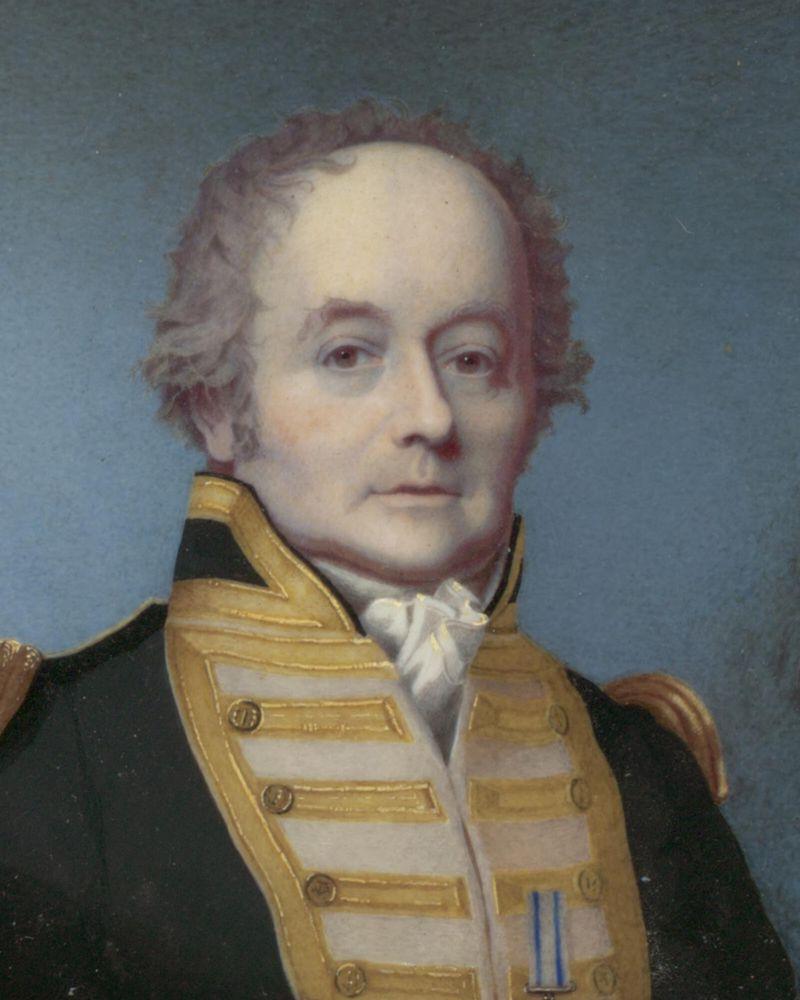
William Bligh was born on 9 September 1754, most likely in Plymouth, where he was baptised at St Andrew's Church on 4 October and where his father, Francis, was a customs officer, though the family's Cornish seat at St Tudy has long claimed him too. His name went on a ship's books when he was seven, as was common for a young gentleman meant for the navy, and at twenty-one James Cook chose him as sailing master of the Resolution for the third Pacific voyage; after Cook was killed in Hawaii, Bligh helped navigate the ships home in 1780. In 1781 he married Elizabeth Betham on the Isle of Man, and after the American war he commanded merchant ships, with a young Fletcher Christian among the men he taught navigation. In 1787 he was given the armed transport Bounty to carry breadfruit plants from Tahiti to the West Indies as food for enslaved workers. On 28 April 1789, three weeks out of Tahiti, Christian seized the ship, and Bligh and eighteen men were cast off in the open launch, which he brought to Kupang in Timor after a voyage of forty-seven days and 3,618 nautical miles. A court-martial honourably acquitted him over the loss of the ship, and his Narrative of the mutiny (1790) and A Voyage to the South Sea (1792) told the story his way, until Edward Christian's Appendix of 1794 told it another, and the pamphlet war that followed fixed his name to tyranny. He carried breadfruit to Jamaica on a second voyage, fought at Camperdown in 1797 and under Nelson at Copenhagen in 1801, and in 1806 became governor of New South Wales, where his war on the officers' rum trade ended with soldiers of the New South Wales Corps arresting him on 26 January 1808. He went on to chart Dublin Bay, rose to the rank of vice-admiral, and died in London on 7 December 1817.
Cast off from the Bounty in a twenty-three-foot launch with eighteen men, a quadrant and a compass, Bligh made scales from two coconut shells and weighed out each man's bread against a pistol ball, a twenty-fifth of a pound. That ball, engraved later with what it had measured, is now in the National Maritime Museum at Greenwich.
The first button needs the app on this device; the second gets it there.