
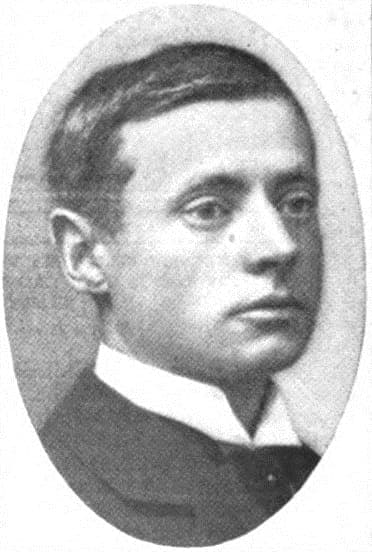
Author
W.W. Jacobs
- Lived
- Lived 1863 to 1943
- From
- From English
- Born in
- Born in London, England
Born William Wymark Jacobs on September 8, 1863, at 5 Crombie's Row in Mile End Old Town, east London, he was the son of William Gage Jacobs, manager of the South Devon wharf beside St Katharine Docks. His mother, Sophia, died while the children were small, and his father remarried and had seven more. The Oxford Dictionary of National Biography records that the boy ran wild in Wapping, and the barges, night-watchmen and dockside lodging houses he grew up among furnished nearly everything he later wrote. He attended a private London school and then the Birkbeck Literary and Scientific Institution, and in 1879, at sixteen, took a clerkship in the Post Office Savings Bank that held him for twenty years. His first story appeared in 1885 and recognition came slowly, but Many Cargoes (1896) reached a fourteenth edition within a year, and Punch summed up his territory as men who go down to the sea in ships of moderate tonnage. Arnold Bennett was astonished to hear in 1898 that Jacobs had turned down fifty pounds for six stories; he left the Post Office the following year, and from October 1898 The Strand carried his work almost until his death. The Skipper's Wooing (1897), Light Freights (1901), Dialstone Lane (1904) and Sailors' Knots (1909) built his reputation on a Wapping night-watchman who narrated the misfortunes of three feckless sailors, Ginger Dick, Sam Small and Peter Russet. Then, in Harper's Magazine for September 1902 and in the collection The Lady of the Barge that same year, came The Monkey's Paw, a story of three wishes and a knock at the door that has outlived every comic page he wrote. He married Agnes Eleanor Williams in 1900; she became a suffragette with an arrest record, while he described his own later politics as Conservative and Individualistic. They had five children and settled at Loughton in Essex. His fiction thinned after the First World War, and Sea Whispers (1926) was his last collection of new stories. He died at Hornsey Lane, Islington, on September 1, 1943, a week short of eighty.
On 7 January 1914 the Dickens Fellowship put John Jasper on trial for the murder of Edwin Drood at the King's Hall in Covent Garden. G.K. Chesterton sat as judge, George Bernard Shaw was foreman of the jury, and Jacobs sat on it. They returned a verdict of manslaughter, and Chesterton fined everyone present for contempt of court.
The first button needs the app on this device; the second gets it there.
In the canon
- The Monkey's Paw1902