
Old English · c. 700–1000
Beowulf
By no one whose name survives.
- Composed
- Composed Anglo-Saxon England
- Survives in
- Survives in One manuscript
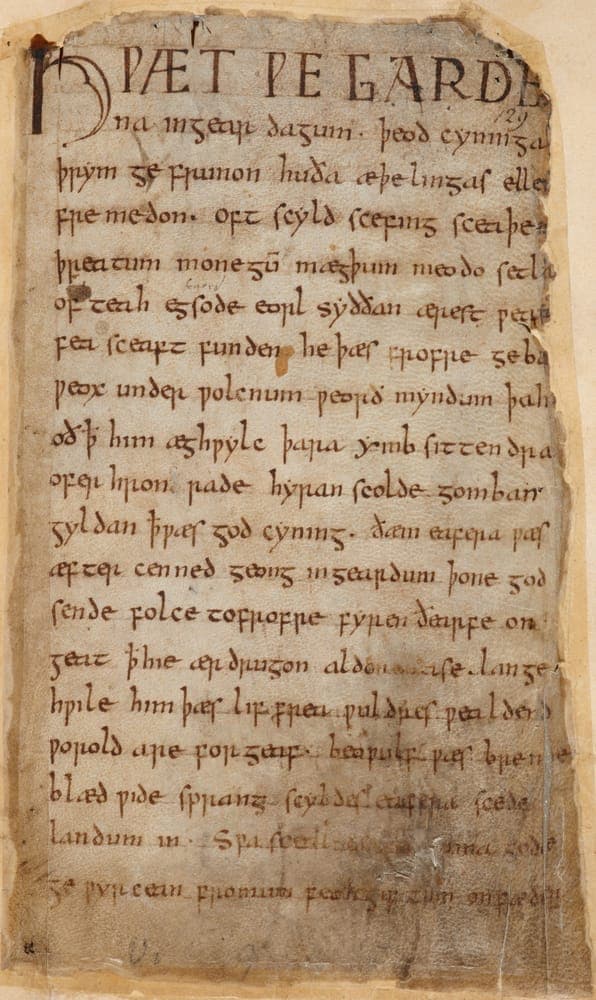
Beowulf is set entirely in Scandinavia and never once mentions England. Its Danes drink in a hall called Heorot, its hero is a Geat from what is now southern Sweden, and the single event in it that historians can pin to a calendar is a raid on the Frisian coast by King Hygelac, who appears in Gregory of Tours as Chlochilaicus, killed by the Franks in the early sixth century. The poem was made in England all the same, in Old English, in the alliterative long line that was the common measure of Germanic verse: four stresses, a pause at the middle, the halves hooked together by repeated sounds rather than rhyme. It was a form built to be spoken aloud in a hall, and it carries a vocabulary of compounds invented for that purpose, so the sea becomes the whale-road and a king becomes the ring-giver. What makes the poem strange is the distance between its matter and its makers. The English who wrote it down were Christians; the world they were writing about was not. The poem neither converts its heroes nor condemns them. The narrator knows about God, the characters do not, and the poet holds both facts steadily at once, admiring men whose courage he cannot promise will save them. Grendel is handed a genealogy out of Genesis and descended from Cain. The funeral that ends the poem is a pagan burning. And it was copied into a book of monsters. The volume it sits in collects a life of Saint Christopher, who in the Old English version is a giant, an illustrated catalogue of the marvels of the East, and a letter in which Alexander describes the impossible creatures he met in India. Whoever assembled that book appears to have wanted Beowulf for its giants.
The question of who
Nobody signed it. The dispute is not over which name to attach but over when: R. D. Fulk reads the poem's metre and archaic word forms as demanding composition close to 700, and Leonard Neidorf's 2014 collection gathers the case for roughly 650 to 750. Kevin Kiernan, working from the manuscript itself, argues the poem is contemporary with its only copy, and that the second scribe was still revising as he wrote. Of any maker, two hands survive, and both belong to copyists.
How it nearly did not
Fire took it twice. Ashburnham House burned in 1731 and the leaves came out scorched, then went on shedding letters at the brittle edges until they were mounted in paper frames in 1845. Nearly two thousand letters are gone. In 1807 a British fleet shelled Copenhagen and burned Thorkelin's twenty years of work; only his two transcripts survived, and they now supply what the edges lost.
A thousand years
- c. 700–1000 A poet shapes Beowulf, when, exactly, is still fought over
- c. 1000 Two scribes copy it into the Nowell Codex, the hand changes in the middle of line 1939
- 1731 Ashburnham House burns, the edges char, and go on crumbling for a century
- 1787 Thorkelin has the poem copied twice, the copyist who knew no Old English made the better copy
- 1815 The first edition is printed, in Latin, as a Danish poem
- 1936 Tolkien argues it is a poem, not a quarry, the monsters belong at the centre
- 1999 Heaney's translation becomes a bestseller
- 2015 Electronic Beowulf puts the burnt leaves online, backlighting recovers letters hidden since the fire
- Now Still being read
The first button needs the app on this device; the second gets it there.