
Nahuatl · c. 1550–1585
Cantares Mexicanos
By many hands, over a long time.
- Composed
- Composed Central Mexico
- Survives in
- Survives in One manuscript
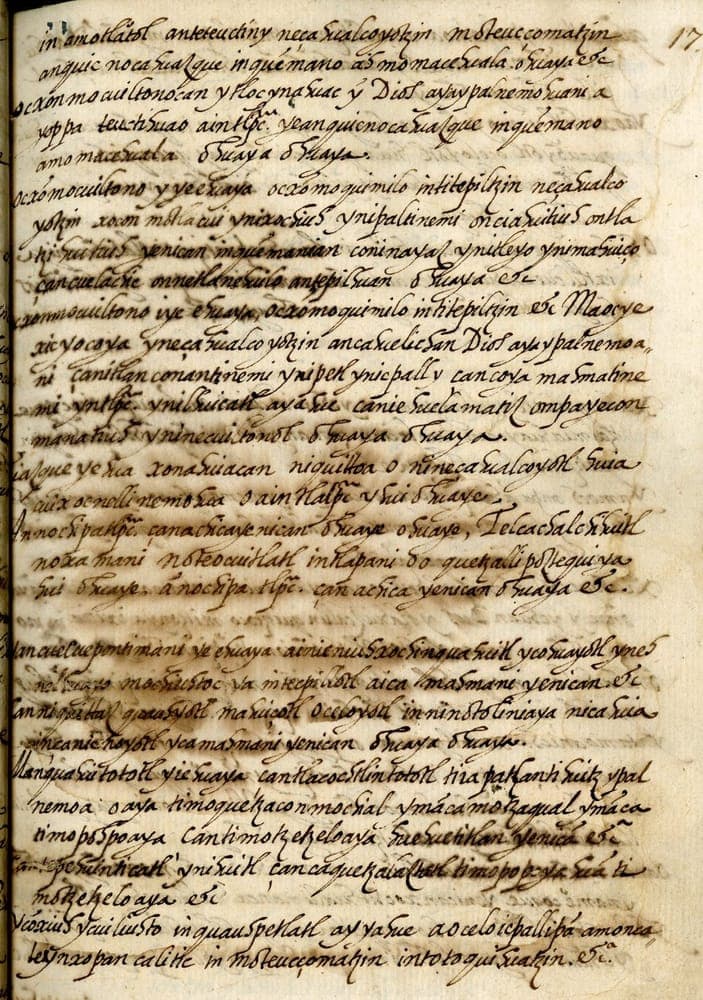
Central Mexico had no single word for poetry, only a paired image: in xochitl in cuicatl, flower and song, what Nahua speakers reached for when they wanted to name the highest human act. A tlatoani, a ruling lord, could also be a singer, and at the fifteenth-century court of Texcoco, Nezahualcoyotl composed and performed songs that his contemporaries and descendants kept singing for generations after his death in 1472. These songs, some named xochicuicatl (flower songs), others icnocuicatl (songs of loss), were sung to drums and danced, and nothing about them required writing. The Spanish conquest of 1521 broke that oral chain at the root, killing the courts that had sponsored the singers and burning the temples where many songs were performed. What followed was an accidental rescue. Franciscan friars, alarmed that Nahua converts kept singing the old verses at feasts the friars suspected of hiding idol worship, trained a generation of Nahua students at the Colegio de Santa Cruz de Tlatelolco to read and write the Roman alphabet their teachers had brought. Those same students, working in and around Bernardino de Sahagún's circle, turned that skill on the very songs their teachers wanted stamped out, writing down what singers could still remember before the memory went with them. The result, copied out across the second half of the sixteenth century, is not one author's book but ninety-one songs from many hands and several courts and generations, gathered the way a collector gathers a village's whole repertoire before its last singer dies, in a script none of the original singers had ever used.
The question of who
Nezahualcoyotl signed nothing himself. The credit comes from song headers a scribe added generations after his death, naming him alongside other lords, among them Nezahualpilli, Axayacatl, and Cuacuauhtzin, remembered for a lament on his own betrayal. Whether these headers preserve real memory or later invention is the field's central argument: John Bierhorst's 1985 translation reads many attributed songs as post-conquest compositions summoning warrior ancestors, while Karttunen, Lockhart, and Miguel León-Portilla's school read the same headers as genuine, naming a lyric tradition older than the conquest.
How it nearly did not
Franciscan friars wanted the old songs suppressed, not kept, and training scribes to copy them down in order to root out "idolatry" is what saved them instead. The finished manuscript sat bound among other colonial papers in Mexico City for three centuries, unread as literature, until the historian José María Vigil brought it before the International Congress of Americanists in 1895 and identified it as authentic sixteenth-century Nahua song.
Nearly six hundred years
- c. 1430s Nezahualcoyotl composes at the Texcoco court, an oral art, sung and danced, never yet written down
- 1490 Tecayehuatzin convenes the Colloquy of the Flowers, poets argue whether song is the only truth on this earth
- 1521 Tenochtitlan falls, the courts that had sponsored the singers go with it
- c. 1550 Nahua scribes at Tlatelolco begin taking down the old songs, trained by the friars to write the alphabet meant to convert them
- c. 1585 The Cantares Mexicanos reaches its surviving form, ninety-one songs copied into one manuscript
- 1895 José María Vigil brings the manuscript to the Congress of Americanists, after three centuries unread as literature
- 1985 Bierhorst publishes the first complete English translation, and reads the songs as "ghost songs"; most Nahuatl scholars disagree
- Now Still being read
The first button needs the app on this device; the second gets it there.