
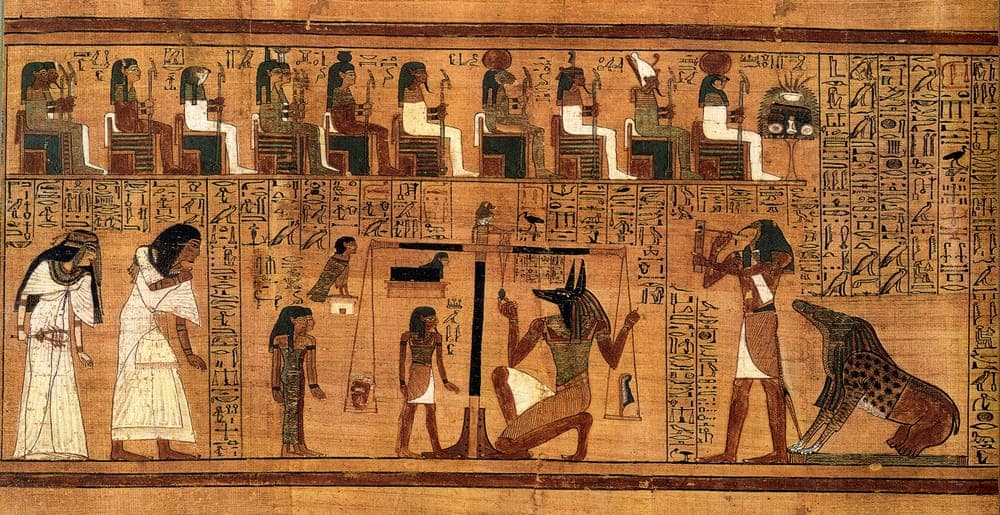
Egyptian · c. 1550 BCE
Egyptian Book Of The Dead
By many hands, over a long time.
- Composed
- Composed Thebes, Egypt
- Survives in
- Survives in Papyrus scrolls
Egypt had been burying its dead with spells for eight hundred years before there was a Book of the Dead. Around 2350 BCE the Pyramid Texts were cut into the burial-chamber walls of Unas's pyramid at Saqqara, nearly three hundred spells reserved for one king's passage into the sky, never illustrated, never meant for any eye but his own and the gods'. By the Middle Kingdom, close to 2100 BCE, the same spells and hundreds of new ones were painted inside the wooden coffins of provincial officials, a shift Egyptologists call the democratization of the afterlife: you no longer needed to be pharaoh, only rich enough to own a coffin. The decisive change came at the start of the New Kingdom, around 1550 BCE, when the spells left the coffin altogether and were copied instead onto a papyrus scroll that could be bought, illustrated, and buried with anyone whose family could pay a scribe. Roughly 192 of these spells are known today, and no single surviving copy contains them all; a buyer, or an heir arranging a hasty funeral, chose however many the household could afford, in whatever order a workshop's scribes happened to have to hand. Temple workshops kept scrolls half finished in stock, the spells and pictures already inked, with a blank column left wherever the deceased's name belonged, ready to be filled in on short notice. The result was never one book. It was a marketplace of the same few hundred spells, recombined a little differently in nearly every tomb, for as long as fifteen centuries, until shorter descendant texts finally took over.
The question of who
Nobody signs a Book of the Dead. The spells passed through generations of temple scribes and priests, each copy assembled by whichever workshop hand was mixing spells that week, and no single editor's name survives the way Sin-leqi-unninni's does for Gilgamesh. The only name reliably attached to any copy is the buyer's, like the Theban scribe Ani, and even that is often a later addition: on his own scroll, its first sixteen feet were written for him, and the remaining sixty-two, out of a seventy-eight-foot roll, were bought ready-made.
How it nearly did not
Egypt's dry sand did the hard work: hundreds of Books of the Dead survived physically intact in sealed tombs for three thousand years. What nearly didn't survive was the ability to read them. The last dated hieroglyphic inscription was cut in 394 CE; after that the script went dark for fourteen centuries, and a papyrus is no use once nobody alive can sound out a single spell.
Three thousand five hundred years
- c. 1550 BCE The spells move from coffin to papyrus, sold to anyone who could pay a scribe, not reserved for a king
- c. 1250 BCE The scribe Ani buys his copy, most of it ready-made; his name filled in afterward, in a hurried hand
- c. 50 BCE The last full copies are made, shorter descendant funerary texts begin to replace it
- 394 CE Hieroglyphic writing falls silent, the last dated hieroglyphic inscription known anywhere in Egypt
- 1822 Champollion makes hieroglyphs legible again, fourteen centuries after anyone last read a spell
- 1842 Lepsius names and numbers the spells, Das Todtenbuch, after a single papyrus in Turin
- 1888 Budge takes the Papyrus of Ani out of Thebes, the 78-foot scroll is cut into 37 pieces to ship it
- Now Still being read
The first button needs the app on this device; the second gets it there.