
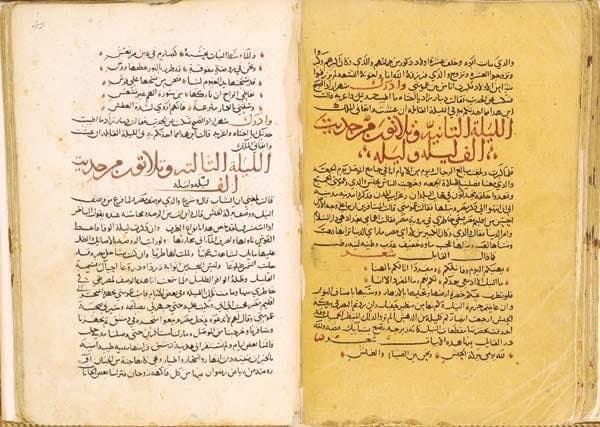
Arabic · 9th–18th centuries
One Thousand and One Nights
By many hands, over a long time.
- Composed
- Composed Persia to Cairo
- Survives in
- Survives in Rival manuscripts
In the tenth century a Baghdad bookseller named Ibn al-Nadim sat down to catalogue every book he had heard of, and among them he listed a Persian collection called Hazar Afsan, A Thousand Tales. He described its frame: a king who kills each wife after the wedding night, until one clever woman saves herself by breaking off a story every dawn. That frame is the one still running. Ibn al-Nadim reported that the Persian book held two hundred stories despite its title, and he did not think much of it. No copy of the Hazar Afsan survives, so what the Arabic borrowed from it and what the Arabic invented is argued over rather than known. What is clear is that Baghdad absorbed the thing, Arabised the names, and then never stopped adding. The Nights was not written. It accreted, over roughly a thousand years, out of storytellers working marketplaces and coffee houses from Damascus to Cairo and scribes who copied whatever sold. Nobody in Arabic letters regarded this as literature. Adab was refined prose for educated men, and the Nights was coarse, improbable and badly made, the kind of thing told to a crowd for coins. Al-Masudi called it Alf Khurafa, a thousand entertaining tales, and khurafa carries the sense of a fable not worth believing. So the book was never authored, never fixed, and never protected. It grew in two directions at once: a Syrian line that stayed short and stable, and an Egyptian line that kept swelling with whatever came to hand. Late in the eighteenth century a compiler in Cairo, working toward a title that had always been a figure of speech for a great many, padded and subdivided the material until the nights numbered exactly one thousand and one. The number was an idiom. Somebody made it literal.
The question of who
Hanna Diyab, a Maronite from Aleppo, reached Paris in 1708 as a French collector's servant and interpreter. On 17 March 1709 he met Antoine Galland, then years into his translation, and told him stories. Galland's diary records the sessions. Aladdin and Ali Baba come out of them, and appear in no Arabic manuscript predating Galland. Diyab's own memoir surfaced in the Vatican Library in 1993, catalogued as anonymous because its opening pages were gone. Bottigheimer and Horta now argue he should be read as their author.
How it nearly did not
Scrap paper preserved the oldest trace of it. The two ninth century folios Nabia Abbott identified in 1948 lasted because someone reused the back for a letter and a legal note. Nothing about the Nights was protected. Arabic letters classed it as vulgar entertainment rather than adab, so no library curated it, and the earliest substantial copy to reach us is three volumes Galland happened to buy in 1701.
Twelve hundred years
- c. 800 Baghdad Arabises a Persian book of tales, Hazar Afsan becomes Alf Layla, A Thousand Nights
- 987 CE Ibn al-Nadim catalogues it in the Fihrist, a coarse book, without warmth in the telling
- 14th or 15th c. The Galland manuscript is copied in Syria, 282 nights, breaking off in the middle of a tale
- 1704 Galland begins publishing it in French, twelve volumes; the last appeared after his death
- 1709 Hanna Diyab tells Galland the orphan tales, Aladdin and Ali Baba enter the book in Paris
- 1835 Bulaq prints the padded Egyptian text, the nights made to number literally one thousand and one
- 1949 Nabia Abbott publishes a ninth century fragment, two folios, the back reused as scrap paper
- 1984 Mahdi's critical edition strips it back, the Syrian text alone, without the European additions
- Now Still being read
The first button needs the app on this device; the second gets it there.