
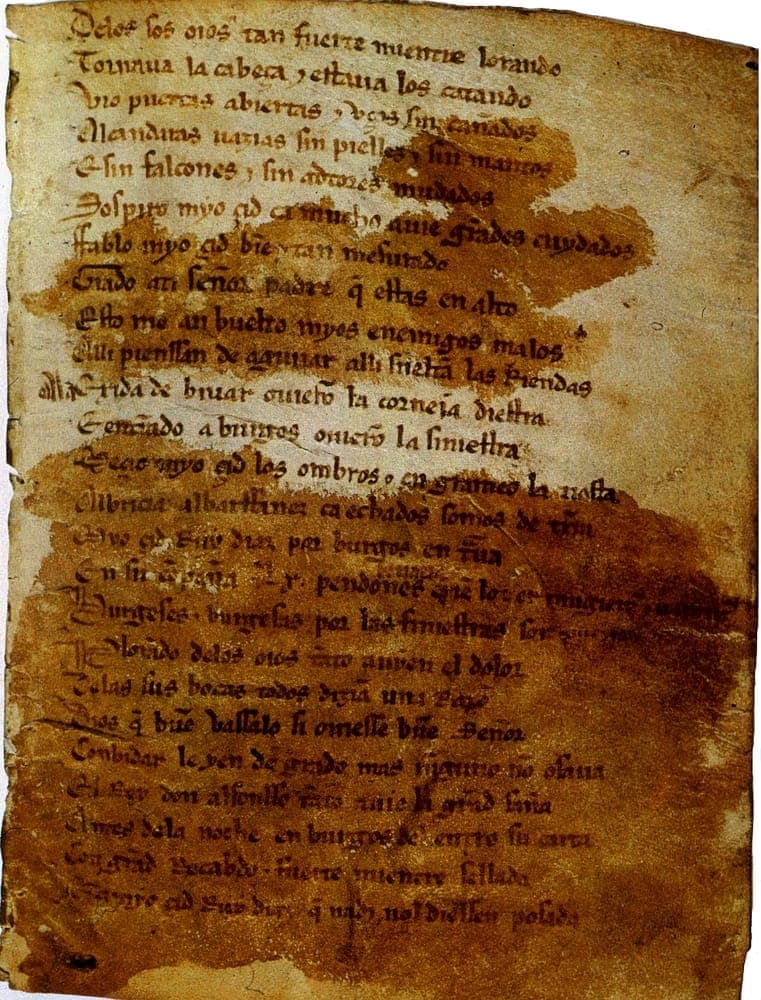
Old Spanish · c. 1200
Poem of the Cid
By someone whose name is argued over.
- Composed
- Composed Castile
- Survives in
- Survives in One manuscript
Rodrigo Diaz de Vivar was a real Castilian knight, born around 1043 in a village a few miles from Burgos, who spent his career doing exactly what an epic hero is not supposed to do: switching sides. King Alfonso VI exiled him from Castile in 1081 after an unauthorized raid, and rather than starve in disgrace, Rodrigo took service with the Muslim rulers of Zaragoza, campaigning under their banner for the better part of a decade. He learned the politics and law of al-Andalus well enough that by 1094 he had besieged and taken Valencia in his own name, ruling it as a Christian prince inside Islamic Spain until his death in 1099. None of that squares easily with loyal vassalage, and Castile a century later needed him to. The poem that survives opens on the exile itself, the empty house at Vivar, and spends its first two thirds rebuilding Rodrigo's reputation through service and the conquest of Valencia, so that by its final act the wronged man stands as the king's most trusted subject after all. Then it does something almost no other medieval epic does: it settles its climax in a courtroom. When Rodrigo's sons in law, the Infantes de Carrion, savagely abandon his daughters on the road from Valencia, the poem answers the outrage not with a private killing but with a summoned royal court at Toledo, a formal accusation, and a judicial duel granted only after the law has had its say. That choice, procedure over vendetta, is the poem's real signature. Unlike the chansons de geste being sung across the Pyrenees at the same date, there are no angels, dragons, or magic swords here, only inventories of silver, named towns along real roads, and a courtroom scene precise enough that scholars read it as the work of someone who had actually stood in one.
The question of who
Ramon Menendez Pidal argued the poem grew out of oral cantares sung by jongleurs and refashioned across generations, its surviving text descending from a lost version of around 1140. Colin Smith answered that a single writer, trained in notarial law rather than folk memory, composed it close to 1207 from written chronicle sources. Per Abbat, the only name the poem itself supplies, later scholarship reads as that writer's copyist rather than its author: medieval scribes routinely signed escrivio, wrote, to mean copied.
How it nearly did not
The poem survives in one medieval copy, itself missing its opening leaf and two others from the middle. It sat for at least a century in the town hall strongbox of Vivar, the Cid's own birthplace, then vanished from any record. It resurfaced only in the mid nineteenth century in a private scholar's hands, and reached public safekeeping just once, by national purchase in 1960.
Eight hundred years
- c. 1200 The poem takes the shape that survives, Menendez Pidal dated an oral version to about 1140; Colin Smith argued a single author wrote it fresh, close to this date
- 1207 Per Abbat copies it out, and dates it, his colophon names him and gives the month and year in the Spanish era
- c. 1320s An unnamed scribe copies the copy, keeps Per Abbat's name and 1207 date, a century after the fact
- 1596 Juan Ruiz de Ulibarri transcribes it at Vivar, the earliest proof it still existed, sitting in the town hall's own chest
- 1779 Tomas Antonio Sanchez prints it for the first time, after five and a half centuries as manuscript alone
- 1863 The Marques de Pidal owns it, bought from the scholar Pascual de Gayangos, who had it from an untraced source
- 1960 Bought for the nation, the Fundacion Juan March pays the Pidal heirs and gives it to the Biblioteca Nacional
- Now Still being read
The first button needs the app on this device; the second gets it there.