
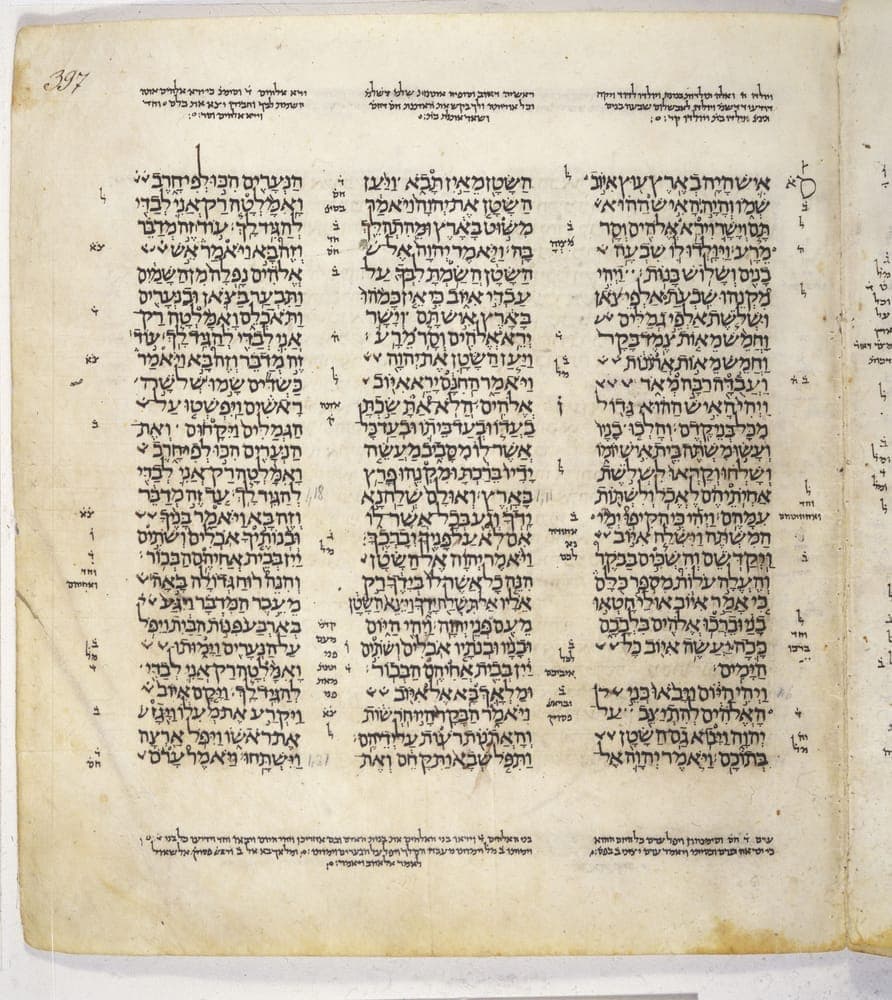
Hebrew · c. 6th–4th century BCE
The Book of Job
By no one whose name survives.
- Composed
- Composed Persian-era Levant
- Survives in
- Survives in Masoretic codices
Uz was not Israel. The book opens by placing its hero outside the covenant entirely, in a land east of everywhere, and it never once mentions Moses, Sinai, the exodus or the temple. That distance is deliberate and it is old. Behind the poem sits a folk tale, the story of a blameless man who loses everything and does not curse God, and the prose that carries it is plainer and older than the verse it now frames. The ancient Near East had been telling versions of that story for a very long time. Babylonian scribes copied Ludlul bel nemeqi, the poem of a righteous man struck down without cause, more than a thousand years before any of Job was written, and the Babylonian Theodicy set a sufferer and a friend arguing the same question in alternating speeches. Job's poet inherited a question that was already ancient and already had its answers ready. What the poet did with it was new. Somebody took the folk tale, cut it open between the disaster and the restoration, and poured thirty-nine chapters of verse into the gap, in which the blameless man does precisely what the tale says he did not do. He complains, at length. His friends answer him with the orthodox consolations, and he refuses them one by one. The language dates the work. The poem's Hebrew is threaded with Aramaic, which only became the common tongue of the Levant under the Persians, so the verse is generally placed between the sixth and the fourth centuries BCE, with the exile at one end of the argument and the Hellenistic period at the other. What survives is that seam: a patient old story with a furious poem wedged inside it, and the two have never quite agreed.
The question of who
Nobody signed the book, and no scholar has a name to propose. The argument is about hands, not identities. The prose frame and the poetic dialogue differ in language and temper, which is why most critics read the folk tale as older material the poet reworked. Elihu is the sharper dispute. Since Eichhorn in the 1780s and Stuhlmann in 1804, many have judged his four speeches a later insertion: he appears nowhere else in the book, and the style shifts around him. No manuscript preserves a Job without them.
How it nearly did not
Job's Hebrew was the thing at risk, never the parchment. The book was scripture and was copied without interruption, but it carries more words occurring nowhere else in the Bible than any other book, and the sense of them was already slipping away by the second century BCE. The Greek translators, faced with it, cut a sixth of the poem. What almost failed to reach us was the meaning.
Two and a half thousand years
- before the 6th century BCE A folk tale of a blameless man in Uz, the prose frame, older than the poem and set outside Israel
- c. 5th century BCE A poet cuts the tale open and fills it with verse, Aramaic threaded through the Hebrew places it under the Persians
- c. 2nd century BCE The Greek translators cut a sixth of it, the Septuagint Job runs some four hundred lines short
- c. 240 Origen marks the missing Greek lines with asterisks, the gaps filled in from Theodotion's version
- 1008 Samuel ben Jacob finishes the Leningrad Codex in Cairo, the Job nearly every modern translator still works from
- 1611 The King James Version
- 1956 Cave 11 gives up an Aramaic Job, 11Q10, thirty-nine columns, copied around the first century
- Now Still being read
The first button needs the app on this device; the second gets it there.