
Pali · c. 3rd century BCE
The Dhammapada
By many hands, over a long time.
- Composed
- Composed North India
- Survives in
- Survives in Palm leaf copies
The Buddha taught out loud, for around forty-five years, walking between the towns of the Ganges valley, and nothing he said was written down in his lifetime. That is not a gap in the record. Early Buddhism ran on speech by design: the monastic rule contains no regulations about writing materials, and the tradition described its own activity in verbs of listening and reciting. So the sangha built its library out of people. Monks called bhanakas, reciters, each took custody of a portion of the teaching and held it in memory, meeting to recite in groups so that the group caught what the individual dropped. The commentaries name reciters of the long discourses and reciters of the middle-length ones, and they name Dhammapada-bhanakas, monks whose entire specialism was these verses. What the reciters carried was not a book. It was a canon of talk, thousands of discourses, each pinned to the occasion that prompted it, and threaded through all of it were verses: single stanzas that travelled well because they were the part people remembered. Somebody pulled four hundred and twenty-three of them out and sorted them under twenty-six headings. The twin verses. Flowers. The fool. The wise man. The elephant. That anthology is the Dhammapada, the second book of the Khuddaka Nikaya in the Sutta Pitaka, and Glenn Wallis dates the impulse behind it to the third century BCE and to a practical need: the early communities had to make an ascetic's teaching usable by householders, and a book of quotable stanzas is what that looks like. This is why no author is named, and why hunting for one misreads the object. Nobody wrote the Dhammapada. It was assembled, by editors working inside a tradition that had no reason to sign anything, because a reciter does not sign what he recites.
The question of who
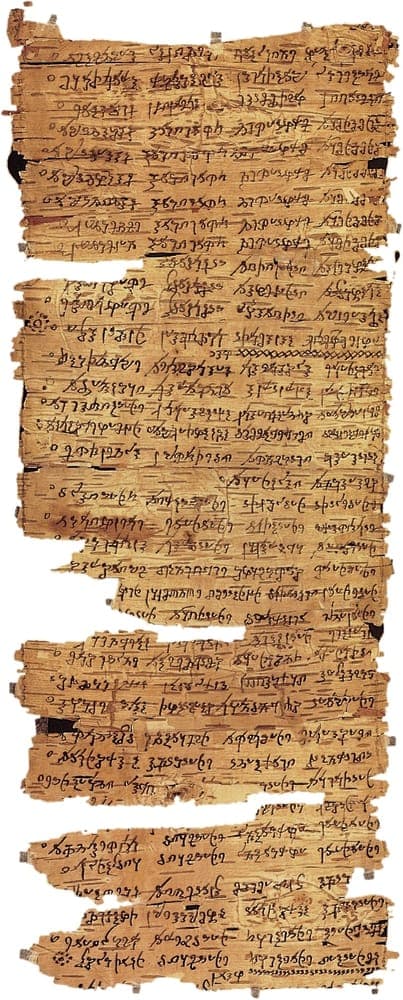
Brough compared the Pali text with the Gandhari Dharmapada and the Sanskrit Udanavarga and found roughly three hundred and thirty verses common to all three, along with sixteen shared chapter headings. His conclusion was that they descend from a common ancestor and that none of them is it. The Pali version is not the original; it is one school's anthology of material older than the anthology. The verses are traditionally the Buddha's. The book is the work of compilers who left no name.
How it nearly did not
Palm leaf rots. In the humidity of Sri Lanka a manuscript lasts three or four centuries at best, so no ancient copy of this text exists and none ever could; the oldest surviving Pali Dhammapada dates to around 1500. The book reached us because monks kept writing it out again before the leaves failed, century after century, across five countries, and never stopped.
Twenty-three centuries
- c. 3rd century BCE Four hundred and twenty-three verses gathered into an anthology, pulled from a canon that existed only in memory
- 29 BCE Five hundred monks commit the canon to palm leaf at Aluvihare, after four centuries of reciting it
- c. 5th century Buddhaghosa's commentary supplies 305 stories, an occasion for almost every verse
- c. 1500 The oldest Pali copy that still exists is written, everything older had already rotted and been replaced
- 1848 British troops burn the Aluvihare library, putting down the Matale rebellion
- 1870 Max Muller's complete English translation, reprinted in 1881 as volume ten of the Sacred Books of the East
- 1892 A birch bark Dharmapada is found near Khotan, first or second century, and in Gandhari, not Pali
- Now Still being read
The first button needs the app on this device; the second gets it there.